Successful dog mating depends on timing. The canine heat cycle has four distinct stages, but only during a narrow window — typically just 4-5 days — is your female dog actually fertile and ready to mate. This complete dog mating guide explains every stage of the heat cycle, the signs to watch for, and how to time breeding correctly.
- The dog heat cycle has 4 stages: proestrus, estrus, diestrus, and anestrus
- Dogs are only fertile during estrus, which lasts 5-9 days on average
- The optimal breeding window is 48-72 hours after ovulation (days 4-6 post-LH surge)
- Progesterone testing is the most accurate method to time breeding—ovulation occurs at 5 ng/mL
- Up to 75% of breeding failures are due to incorrect timing, not fertility problems
How Dog Mating Works: The Basics
Dog mating is the physical breeding process between an intact male (the stud) and a female (the dam) during her fertile window. Unlike many species, dogs only mate successfully when the female is in standing heat — the brief portion of her heat cycle when her body is hormonally ready to conceive. Outside that window, she will reject the male, no matter how interested he is.
When timing is right, the stud approaches, mounts, and the pair forms what breeders call a “tie” — a physiological lock that lasts anywhere from 5 to 30 minutes. This tie is normal and should never be interrupted. After the tie releases, fertilization happens internally over the next 2 to 5 days as the female’s eggs mature.
The two things that decide whether a dog mating actually produces a litter are the female’s heat cycle stage and the timing of the breeding within that stage. Get the timing wrong and even a healthy, fertile pair will fail to conceive. That is why understanding the heat cycle (covered in the next section) is the foundation of every successful dog mating, and why progesterone testing has become the gold standard for serious breeders.
Once you’ve timed her cycle correctly, you can find a stud dog near you through PairMyPet’s verified directory.
The Four Stages of the Dog Heat Cycle
According to Cornell University College of Veterinary Medicine, the canine estrous cycle consists of four stages: proestrus, estrus, diestrus, and anestrus. Each stage has distinct hormonal changes and physical signs.
Stage 1: Proestrus (7-10 Days)
Proestrus marks the beginning of the heat cycle. During this stage, estrogen levels rise, causing the vulva to swell and bloody vaginal discharge to appear.
- Swollen vulva (may be subtle at first)
- Bloody vaginal discharge
- Increased urination and marking behavior
- Attracts male dogs but refuses mating
- May become clingy or restless
- Tail tucked close to body when approached by males
Not Ready Yet: During proestrus, your dog will attract males but is NOT yet ready to breed. She will typically snap at or move away from males who attempt to mount.
Stage 2: Estrus – The Fertile Period (5-9 Days)
Estrus is the “standing heat” phase when your dog is actually fertile and receptive to mating. According to VCA Animal Hospitals, estrus begins with a surge in luteinizing hormone (LH) as estrogen decreases and progesterone rises.
- Discharge becomes lighter—watery and pinkish (salmon-colored)
- “Flagging” behavior: tail held to the side when touched
- Actively seeks out male dogs
- Stands still and allows mounting (standing heat)
- Vulva softens and may appear less swollen
- Increased affection and playfulness
- Presenting hindquarters to males
Timing Varies Widely: According to Dr. Fran Smith, a board-certified theriogenologist, both proestrus and estrus can range from 3 to 21 days. This is why behavioral signs alone are unreliable for timing breeding.
Stage 3: Diestrus (60-90 Days)
Diestrus follows estrus whether or not breeding occurred. Progesterone levels remain high during this stage. If pregnant, this is when your dog carries her puppies. If not pregnant, she may show signs of “phantom pregnancy.”
- No longer receptive to males
- Vaginal discharge stops
- Vulva returns to normal size
- Possible mammary gland development
- Nesting behavior in some dogs
Stage 4: Anestrus (4-5 Months)
Anestrus is the resting phase between heat cycles. The reproductive system recovers and prepares for the next cycle. This stage typically lasts 4-5 months but can range from 60-200 days.
When Is a Dog Ready to Mate? Timing the Fertile Window
Understanding exactly when your dog is fertile is critical for successful breeding. According to the Merck Veterinary Manual, up to 75% of breeding failures can be attributed to incorrect timing.
The Optimal Breeding Window
Prime Breeding Time: According to Dr. Fran Smith, the optimal time to breed is 48-72 hours after ovulation. This is because canine eggs need 24-36 hours after ovulation to mature before they can be fertilized.
Here’s how the fertile window breaks down:
| Days Post-LH Surge | What’s Happening | Fertility Status |
|---|---|---|
| Day 0 | LH surge occurs (triggers ovulation) | Not yet fertile |
| Day 2 | Ovulation occurs (progesterone ~5 ng/mL) | Eggs still maturing |
| Days 4-6 | Eggs fully matured and ready | OPTIMAL fertility window |
| Day 7+ | Eggs begin to deteriorate | Fertility declining |
The Traditional “Day 10-14” Rule
Many breeders use the rule of thumb that dogs are most fertile between days 10-14 of the heat cycle. While this works for many dogs, it’s unreliable because:
- Some dogs ovulate as early as day 3 of estrus
- Others may not ovulate until day 18 or later
- Proestrus length varies from 3-21 days
- Behavioral signs don’t always align with ovulation
Methods to Determine Breeding Readiness
1. Progesterone Testing (Most Accurate)
Progesterone testing is the gold standard for timing breeding. According to the AKC, this blood test is the most accurate tool for predicting the optimal breeding window.
| Progesterone Level | Cycle Stage | Breeding Action |
|---|---|---|
| < 1.0 ng/mL | Baseline (early proestrus) | Too early—retest in 2-3 days |
| 1.5-2.5 ng/mL | “Day Zero” – LH surge occurring | Ovulation imminent—test daily |
| 5 ng/mL | Ovulation occurring | Breed in 2 days (fresh semen) |
| 10-15 ng/mL | 2-3 days post-ovulation | OPTIMAL for natural breeding |
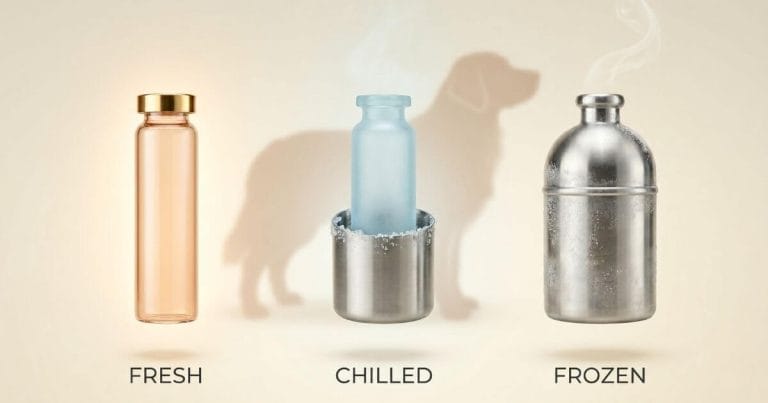
| 15-20 ng/mL | 3-4 days post-ovulation | Best for frozen semen |
| 20+ ng/mL | Late estrus | Fertility declining |
Begin progesterone testing 5-6 days after the first sign of bleeding to establish a baseline (should be very low).
If progesterone is still low (< 1.5 ng/mL), wait 2-3 days before retesting.
Once progesterone starts rising (> 1.5 ng/mL), test every 1-2 days to catch ovulation at 5 ng/mL.
When progesterone reaches 5 ng/mL, breed 2 days later for natural/fresh semen or 3 days later for frozen semen.
Lab Units Matter: Most U.S. labs report progesterone in nanograms per milliliter (ng/mL). However, some labs (including Michigan State University and Canadian labs) report in nanomoles per liter (nmol/L). One ng/mL equals approximately 3.18 nmol/L—always confirm which units your lab uses.
2. Vaginal Cytology
Vaginal cytology examines cells collected from the vaginal lining under a microscope. According to UC Davis School of Veterinary Medicine, this is an economical way to estimate the stage of the heat cycle.
As estrogen rises during proestrus and estrus, vaginal cells become “cornified” (keratinized). The percentage of cornified cells indicates cycle stage:
- Early proestrus: < 50% cornified cells
- Late proestrus: 50-80% cornified cells
- Estrus: 80-100% cornified cells (“superficial” and “anuclear”)
- Diestrus: Sharp drop in cornified cells
Limitation: Vaginal cytology confirms your dog is in estrus but cannot pinpoint ovulation. For precise timing, combine cytology with progesterone testing—start progesterone tests when cornification exceeds 70%.
3. Behavioral Signs
While less precise than testing, behavioral signs help identify when your dog is entering her fertile period:
| Sign | What It Means | Reliability |
|---|---|---|
| Flagging | Tail held to the side when touched near hindquarters | Good indicator of estrus |
| Standing Heat | Allows mounting without moving away | Moderate—may occur before optimal fertility |
| Discharge Color | Changes from bloody to pinkish/straw-colored | Moderate—timing varies by dog |
| Male Interest | Males become extremely interested, off food | Good—indicates pheromone release |
How Male Dogs React to Females in Heat
Male dogs don’t have heat cycles, but they exhibit distinct behaviors when a female nearby is in heat. These signs can help you gauge your female’s cycle stage.
- Intense sniffing and tracking behavior
- Restlessness, pacing, and whining
- Loss of appetite
- Increased urine marking
- Escape attempts (digging, jumping fences)
- Mounting behavior (dogs, people, objects)
- Aggression toward other males
When females release the pheromone methyl p-hydroxybenzoate, males can detect it from remarkable distances—experts suggest at least 1.5 km (nearly a mile) and possibly up to 3 km or more.
Breeder Tip: When males become extremely interested—refusing food and constantly focused on the female—she is likely in her optimal fertile period and ready to breed within 2-3 days.
Heat Cycle Timing by Breed Size
The timing of first heat and frequency of cycles varies significantly by breed size. According to VCA Animal Hospitals and PetMD:
| Breed Size | First Heat | Cycle Frequency |
|---|---|---|
| Small Breeds (Chihuahua, Pomeranian) | 4-6 months | Every 4-6 months (up to 3x/year) |
| Medium Breeds (Beagle, Cocker Spaniel) | 6-9 months | Every 6 months (2x/year) |
| Large Breeds (Labrador, German Shepherd) | 9-12 months | Every 6-8 months |
| Giant Breeds (Great Dane, Mastiff) | 12-24 months | Every 12 months (1x/year) |
Breed exceptions: Basenjis and some sled dog breeds typically cycle only once per year, usually in spring.
Wait for Regular Cycles: It can take up to two years for a female dog to develop regular cycles. Many veterinarians recommend waiting until the second or third heat cycle before breeding—typically when the dog is 18-24 months old and fully mature. For more on optimal breeding ages, see our guide to the best age for breeding dogs.
Common Mistakes When Timing Breeding
- Breeding on the first day of standing heat: Many dogs won’t ovulate for several more days
- Relying only on discharge color: The color change doesn’t precisely indicate ovulation
- Using day count alone: “Day 10-14” works for average dogs but misses many
- Single breeding attempt: Multiple breedings over 2-3 days increase success
- Waiting too long: Eggs deteriorate quickly after day 6-7 post-LH surge
- Skipping progesterone testing: The most common cause of missed breedings
- Breeding on the first heat: Young dogs may not cycle normally yet
Signs the Fertile Window Has Passed
Knowing when your dog is no longer fertile helps you avoid wasted breeding attempts:
- Female actively rejects male advances again
- Vaginal discharge stops completely
- Vulva begins to shrink back to normal size
- Progesterone levels exceed 20 ng/mL and are declining
- Vaginal cytology shows sudden drop in cornified cells
- Male dogs lose intense interest
Frequently Asked Questions
A dog’s heat cycle (proestrus + estrus) typically lasts 2-4 weeks, with the entire estrous cycle averaging 18-21 days. However, individual dogs can vary from 14 to 28+ days. The fertile portion (estrus) is only about 5-9 days within this period.
The optimal breeding time is 48-72 hours after ovulation, which corresponds to days 4-6 after the LH surge. Using progesterone testing, breed when levels reach 10-15 ng/mL. Without testing, most dogs are fertile between days 10-14 of the cycle, but this varies significantly.
Key signs your dog is ready include: flagging (holding tail to the side when touched), standing heat (allowing males to mount without moving), lighter discharge (pinkish rather than bloody), softened vulva, and actively seeking male attention. For certainty, progesterone testing showing 5-15 ng/mL confirms optimal fertility.
Flagging is when a female dog holds her tail to the side (like a flag) when you touch her hindquarters or when a male approaches. This behavior signals she is in estrus and receptive to mating. It’s a reliable behavioral indicator that she’s entering her fertile period.
Most dogs go into heat twice per year, approximately every 6 months. However, small breeds may cycle every 4 months (3 times per year), while giant breeds may only cycle once per year. Some breeds like Basenjis typically have one heat per year in spring.
Progesterone testing is a blood test that measures hormone levels to precisely time ovulation and the fertile window. Start testing 5-6 days after the first sign of bleeding. Test every 2-3 days until progesterone rises above 1.5 ng/mL, then test daily. Ovulation occurs at approximately 5 ng/mL; breed 2 days later for best results.
Dog mating only succeeds during the female’s fertile window inside her heat cycle. When she’s in standing heat, the stud mounts and the pair forms a “tie” lasting 5 to 30 minutes that should never be interrupted. Fertilization then happens internally over the following 2 to 5 days. See the How Dog Mating Works section above for the full breakdown of the process.
You can find dog mating near you by creating a free profile on PairMyPet, browsing verified stud dogs by breed and location, and messaging owners directly. Each profile shows health clearances, pedigree, and breeding history so you can discuss timing, fees, and contracts before arranging the mating.
Find the Perfect Breeding Partner
PairMyPet connects responsible breeders with health-tested, verified breeding partners. Find a stud dog near you, browse verified stud dogs by breed, or find a mating partner for your dog — all through one trusted platform.
Start Your SearchFinal Thoughts
Successfully timing breeding requires understanding your dog’s individual heat cycle patterns. While behavioral signs and discharge changes provide helpful clues, progesterone testing remains the most reliable method for identifying the optimal breeding window. Once you’ve confirmed your female is ready, our guide to finding a stud dog can help you select the right breeding partner.
Remember that up to 75% of breeding failures are due to poor timing rather than fertility problems. Investing in progesterone testing can save you time, money, and the frustration of missed breeding opportunities.
Track your dog’s heat cycles carefully, work with a veterinarian experienced in reproduction, and don’t hesitate to use diagnostic tools to maximize your breeding success. If you’re new to breeding, our comprehensive dog breeding for beginners guide covers the entire process from start to finish.
This article was researched using information from Cornell University College of Veterinary Medicine, VCA Animal Hospitals, American Kennel Club, Merck Veterinary Manual, and UC Davis School of Veterinary Medicine.