- Breeding two merle dogs together gives each puppy a 25% chance of being a double merle
- Double merle is linked to deafness, blindness, and other developmental defects
- The merle gene disrupts pigment cells in the inner ear and eyes when inherited from both parents
- DNA testing for the M-locus before any merle pairing is the single most effective way to prevent it
- This guide covers the genetics, the health consequences by breed, cryptic merle risks, testing options, and how to choose a compatible stud safely
The merle coat pattern is one of the most visually striking in dogs, producing a mottled patchwork of colour across breeds like Australian Shepherds, Border Collies, and Great Danes. But when two merle-patterned dogs are bred together, the results can be devastating. Double merle breeding produces puppies with a high risk of congenital deafness, blindness, or both, and the condition is entirely preventable with a single DNA test.
Despite widespread awareness among breed clubs and geneticists, double merle litters still happen every year. Sometimes it is intentional (breeders producing homozygous merles to guarantee all-merle offspring from future pairings). More often, it is accidental, caused by cryptic merles that look solid-coloured but carry a hidden copy of the gene. Either way, the puppies pay the price.
This guide breaks down the science behind double merle, the specific health risks backed by peer-reviewed research, which breeds are affected, and the practical steps every breeder should take before pairing a merle dog with any potential mate.
What Is Double Merle and Why Does It Happen?
A double merle is a dog that inherits the merle gene from both parents, resulting in the MM genotype. The merle pattern is caused by a SINE insertion in the PMEL17 gene (also called SILV), which disrupts normal pigment distribution. One copy of the insertion (Mm) creates the characteristic mottled coat. Two copies (MM) strip pigment from large areas of the body, including structures where pigment is critical for normal development.
The inheritance follows a straightforward Mendelian pattern. When two heterozygous merle dogs (Mm) are bred together, the expected outcomes are:
- 25% non-merle (mm): No merle gene. Solid coat colour.
- 50% merle (Mm): One copy. Standard merle pattern, no elevated health risk from the merle gene itself.
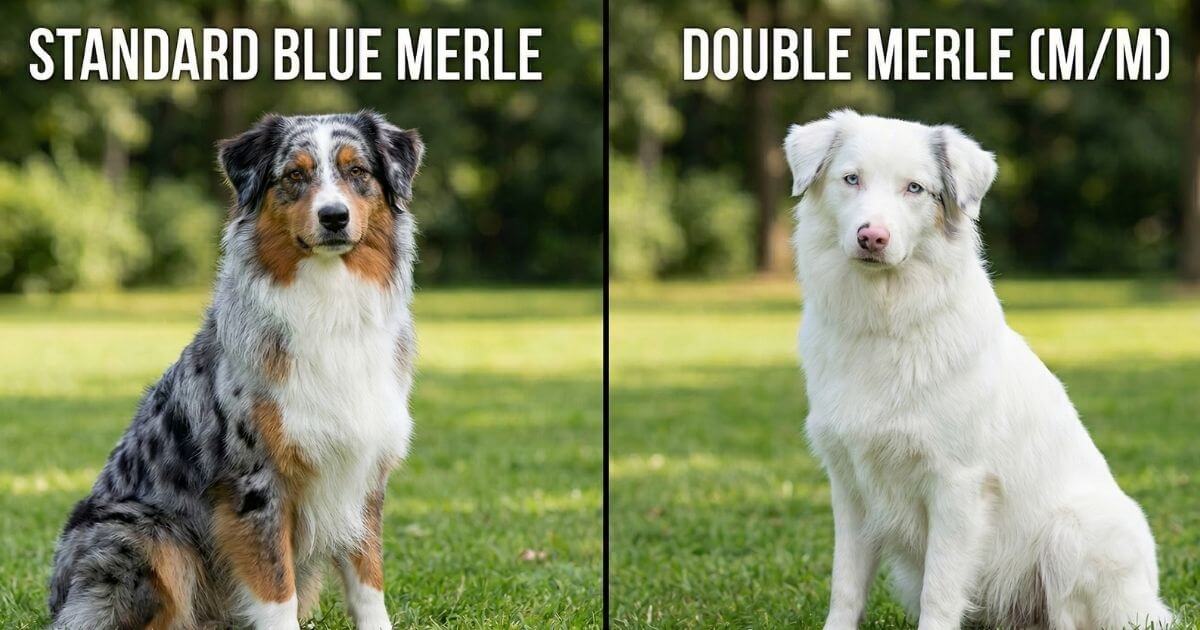
- 25% double merle (MM): Two copies. Predominantly white coat with significant risk of sensory deficits.
| M (from sire) | m (from sire) | |
|---|---|---|
| M (from dam) | MM Double Merle (25%) |
Mm Merle (25%) |
| m (from dam) | Mm Merle (25%) |
mm Non-Merle (25%) |
MM = High risk of deafness/blindness • Mm = Normal merle • mm = Solid colour
The key point: merle is a dominant gene. A dog only needs one copy for the pattern to appear. But the health problems associated with double merle are not simply “more merle.” They stem from the absence of pigment-producing melanocytes in the inner ear and eye structures during embryonic development. Without these cells, the cochlea and retina do not form correctly.
Research by Murphy et al. (2018) showed that the severity of the merle phenotype correlates with the length of the poly(A) tail on the SINE insertion. Longer insertions produce more dilution. In double merles, the combined effect of two insertions eliminates pigment almost entirely, which is why these dogs are often predominantly white.
What Are the Health Risks of Double Merle Dogs?
Double merle dogs face a significantly elevated risk of congenital sensory deficits, primarily deafness and vision impairment. These are not minor cosmetic issues. They are structural developmental failures caused by the absence of melanocytes in the inner ear and eye.
The most comprehensive study on merle-associated deafness was conducted by George M. Strain (2009) at Louisiana State University. His findings across multiple breeds showed that approximately 10% of double merle Catahoula Leopard Dogs were bilaterally deaf, while the rate jumped to roughly 56% in double merle Australian Shepherds. Across all other breeds studied, about 86% of double merles were deaf in both ears.
Hearing Loss
The inner ear relies on melanocytes in the stria vascularis of the cochlea to maintain the endocochlear potential, the electrical charge that allows hair cells to detect sound. Without pigment cells, this potential collapses within the first few weeks of life, and the hair cells degenerate. The result is sensorineural deafness that is permanent and irreversible.
Double merles can be unilaterally deaf (one ear) or bilaterally deaf (both ears). BAER testing (Brainstem Auditory Evoked Response) is the only reliable method for confirming hearing status, as dogs with unilateral deafness often compensate well enough that owners do not notice.
Vision Impairment
Eye abnormalities in double merles range from mild iris irregularities to severe structural defects. Common findings include microphthalmia (abnormally small eyeballs), coloboma (gaps in eye structures), starburst or eccentric pupils, and in extreme cases, anophthalmia (absent eyes). These conditions are present at birth and are not treatable.
The mechanism mirrors the hearing issue: melanocytes in the retinal pigment epithelium are essential for normal eye development. When the double merle genotype prevents these cells from forming, the eye structures develop incompletely.
Other Health Concerns
Beyond sensory deficits, double merles with predominantly white coats are more susceptible to sunburn and UV-related skin damage due to the lack of protective pigment. This increases the long-term risk of squamous cell carcinoma, particularly on the nose, ears, and areas with thin fur.
Some double merles also show skeletal abnormalities, though these are less consistently documented in the literature than hearing and vision defects.
| Trait | Single Merle (Mm) | Double Merle (MM) |
|---|---|---|
| Hearing | Normal hearing | 25–86% bilateral deafness (varies by breed) |
| Vision | Normal vision | Microphthalmia, coloboma, possible blindness |
| Coat | Mottled merle pattern with normal pigment areas | Predominantly white, minimal pigment |
| Skin | Normal sun tolerance | Increased sunburn and UV damage risk |
| Breeding | Safe to breed with non-merle (mm) | All offspring will carry at least one merle allele |
Source: Strain (2009), JVIM; Murphy et al. (2018), Mobile DNA.
The comparison with Waardenburg syndrome in humans is worth noting. This genetic condition also involves melanocyte deficiency and produces similar symptoms: hearing loss, eye pigmentation abnormalities, and patches of white skin or hair. The underlying biology, melanocytes required for both pigmentation and sensory organ development, is shared across mammals.
Which Dog Breeds Carry the Merle Gene?
Merle is not limited to a handful of breeds. The PMEL17 SINE insertion has been documented in more than 20 recognised breeds, plus crossbreeds that inherit it from a merle-carrying parent. However, the risk level varies based on how common merle pairings are within each breed’s population.
Breeds where merle is well-established and commonly bred
These breeds have long histories with the merle pattern. Breed clubs and registries accept merle as a standard colour, and responsible breeders routinely test for the M-locus:
Australian Shepherd: The breed most closely associated with merle. Both blue merle and red merle are standard colours. The Australian Shepherd Health and Genetics Institute (ASHGI) maintains detailed guidance on merle breeding safety. MDR1 testing is also critical for this breed.
Border Collie: Merle occurs naturally in working lines. Blue merle is a recognised colour in both AKC and international registries.
Shetland Sheepdog: Blue merle and sable merle are standard colours. The breed has a well-documented history of merle-related genetic research.
Cardigan Welsh Corgi: One of the oldest breeds to carry merle. Blue merle is a standard colour, distinct from the Pembroke Welsh Corgi (which does not carry merle).
Great Dane: Merle appears in the harlequin colour family. The harlequin pattern involves the merle gene plus a separate modifier (the H-locus), making Great Dane colour genetics particularly complex.
Catahoula Leopard Dog: The merle pattern (called “leopard” in this breed) is a defining characteristic. Strain’s 2009 study included Catahoulas and found lower deafness rates in MM dogs compared to other breeds, suggesting some breed-specific modifier effects.
Dachshund: Merle is called “dapple” in Dachshunds. Double dapple carries the same risks as double merle in any other breed.
Breeds where merle is controversial or newly appearing
French Bulldog: Merle French Bulldogs have surged in popularity, but the AKC does not recognise merle as a standard colour for the breed. Many breed experts argue the gene was introduced through crossbreeding. Merle Frenchies cannot be shown in AKC conformation, and several kennel clubs refuse registration.
Poodle: Merle Poodles are gaining traction in the designer dog market, particularly in Goldendoodle and Bernedoodle lines. The same double merle risks apply.
Chihuahua: The UK Kennel Club no longer registers merle Chihuahuas, citing welfare concerns and lack of historical precedent.
Australian Shepherd
Blue merle, Red merle
AKC Standard🧬 M-locus + MDR1
Border Collie
Blue merle
AKC Standard🧬 M-locus
Shetland Sheepdog
Blue merle, Sable merle
AKC Standard🧬 M-locus
Cardigan Welsh Corgi
Blue merle
AKC Standard🧬 M-locus
Great Dane
Harlequin / Merle
AKC Standard🧬 M-locus + H-locus
Catahoula Leopard Dog
Leopard (merle)
UKC Standard🧬 M-locus
Dachshund
Dapple (merle)
AKC Standard🧬 M-locus
French Bulldog
Merle (introduced)
Not AKC Recognised🧬 M-locus
Poodle
Merle (introduced)
Not AKC Recognised🧬 M-locus
Chihuahua
Merle (controversial)
Varies by Registry🧬 M-locus
If you are breeding any dog in a merle-carrying breed, or any crossbreed that could carry merle from one parent, DNA testing before pairing is essential. Visual coat colour alone is not reliable for determining merle status.
What Is Cryptic Merle and Why Does It Make Breeding Riskier?
A cryptic merle is a dog that carries the merle SINE insertion but shows little to no visible merle pattern. These dogs look solid-coloured to the naked eye, which means breeders who rely on visual assessment alone can unknowingly pair two merle carriers and produce double merle puppies.
The reason cryptic merles exist comes down to allele length. The UC Davis Veterinary Genetics Laboratory has identified four categories of merle alleles based on the poly(A) tail length of the SINE insertion:
- Cryptic merle (Mc): 200–230 base pairs. Minimal to no visible pattern. The insertion is too short to significantly disrupt pigment.
- Atypical/dilute merle (Md or Ma): 231–246 base pairs. Slight dilution, sometimes visible as faded patches or muddy colour.
- Standard merle (M): 247–254 base pairs. The classic merle pattern with distinct mottled patches.
- Harlequin merle (Mh): 255–268 base pairs. More extreme dilution, associated with the harlequin pattern in Great Danes.
The critical issue is that cryptic merles (Mc) can still produce standard merle (M) offspring through a process called allele expansion. The poly(A) tail is unstable during DNA replication, meaning it can lengthen or shorten between generations. A cryptic merle mother can produce a puppy with a standard merle allele, and that puppy, if bred to another merle, can produce double merles.
ASHGI’s guidance on cryptic merles emphasises that DNA testing is the only way to identify these dogs. Their coat may show a single small patch of merle on the body (often hidden under fur), or it may show nothing at all.
Real-world example: A breeder tests what appears to be a solid black Australian Shepherd. The DNA result comes back Mc/m, confirming a cryptic merle carrier. Without the test, this dog could have been paired with a blue merle stud, creating a 25% chance of double merle puppies in every litter.
How Do You Test for Merle Before Breeding?
DNA testing for the M-locus identifies all merle variants, including cryptic merle alleles that are invisible to the eye. The test is simple: a cheek swab or blood draw sent to a genetics lab, with results typically available in 2 to 4 weeks. Every dog in a merle-carrying breed should be tested before breeding, regardless of coat appearance.
Lab Options and What They Offer
| Lab | M-Locus Test | Allele Length Detail | Cost (Approx.) | Turnaround |
|---|---|---|---|---|
| Embark | Yes | Reports allele sizes | $129–$199 (panel) | 3–5 weeks |
| UC Davis VGL | Yes | Full allele classification (Mc, Md, M, Mh) | $50–$80 | 5–10 business days |
| Animal Genetics | Yes | Allele base pair ranges | $25–$40 | 5–10 business days |
| Wisdom Panel | Yes (in breed panels) | Reports merle carrier status | $99–$159 (panel) | 2–4 weeks |
How to Read Your Results
A typical M-locus result will show one of these genotypes:
m/m: Non-merle. No merle allele present. Safe to breed with any dog.
Mc/m or Md/m: Cryptic or dilute merle carrier. Dog may appear solid but carries a merle variant. Should NOT be bred to another merle or merle carrier without understanding the specific allele lengths.
M/m: Standard merle. Classic merle pattern. Safe to breed with non-merle (m/m) only.
M/M or M/Mc or M/Md: Double merle or merle + cryptic combination. High risk genotype. Should NOT be bred to any merle carrier.
The golden rule: If both dogs carry any version of the merle allele (Mc, Md, M, or Mh), consult a veterinary geneticist before proceeding. The safest pairing is always merle (M/m) to non-merle (m/m), which produces approximately 50% merle and 50% non-merle puppies with zero double merle risk.
How to Choose a Compatible Stud When Your Dog Is Merle
Knowing the genetics is one thing. Applying it to real breeding decisions is another. Here is a practical stud selection process for owners of merle dogs.
Before you start browsing studs, get your dog’s M-locus result. If your dog is M/m (standard merle), you need a non-merle (m/m) stud. If your dog is Mc/m (cryptic merle), the same rule applies, but it is even more important because your dog’s merle status may not be visually obvious to the stud’s owner.
Any responsible stud owner in a merle-carrying breed should have M-locus results available. Ask before visiting, before discussing terms, before anything else. If the stud owner does not have the test or refuses to share it, move on.
The compatibility matrix is straightforward:
- Your dog M/m + Stud m/m = Safe. ~50% merle, ~50% non-merle, 0% double merle.
- Your dog M/m + Stud M/m = Dangerous. 25% double merle risk. Do not proceed.
- Your dog M/m + Stud Mc/m = Risky. Cryptic merle can produce standard merle offspring. Consult a geneticist.
- Your dog m/m + Stud M/m = Safe. Same as the first pairing, reversed.
M-locus testing is critical but not sufficient on its own. Breed-specific health clearances through OFA and the CHIC program cover hips, elbows, eyes, cardiac, and breed-specific conditions. For Australian Shepherds, MDR1 testing is equally important. For more on breed-specific requirements, see our DNA testing before breeding guide.
PairMyPet’s direct messaging system lets you discuss health clearances, genetic test results, and breeding terms with stud owners before committing to a pairing. Ask for OFA numbers, allele-specific M-locus results (not just “merle” or “not merle”), and references from previous breedings.
For a broader overview of the stud selection process including contracts, fees, and logistics, read our stud services guide.
Do Any Countries or Registries Ban Merle-to-Merle Breeding?
Yes. The UK Kennel Club has prohibited registering puppies from merle-to-merle breedings since 2013. This means that even if a breeder in the UK intentionally produces a double merle litter, the puppies cannot be registered, which effectively removes their value in the breeding market.
The UK KC also restricts merle registration to breeds where the pattern has documented historical presence. Breeds like Chihuahuas, Pugs, and French Bulldogs cannot be registered as merle, regardless of parentage.
Several FCI (Federation Cynologique Internationale) member countries follow similar guidelines, though enforcement varies. Germany, the Netherlands, and Scandinavian countries have been particularly proactive in restricting colour-based breeding that increases health risks.
In the United States, the AKC does not prohibit merle-to-merle breeding at the registry level. However, individual breed clubs strongly discourage it. The Australian Shepherd Club of America (ASCA) and the ASHGI both publish explicit guidance against merle-to-merle pairings. The Collie Club of America and the American Shetland Sheepdog Association take similar positions.
The Canadian Kennel Club (CKC) does not have a blanket ban but defers to breed club standards, most of which discourage double merle breedings.
The regulatory landscape is shifting toward greater restriction. As DNA testing becomes cheaper and more accessible, the argument for allowing merle-to-merle breeding, even among experienced breeders, weakens. The health outcomes are predictable and preventable.
Responsible Breeding Starts with the Right Information
Double merle is not a mystery. The genetics are well understood, the health risks are documented across multiple peer-reviewed studies, and the prevention is a simple DNA test that costs as little as $25.
Every breeder working with merle-carrying breeds has a responsibility to test before pairing. This means M-locus testing for your own dog and requiring it from any stud owner you work with. It means understanding the difference between standard merle, cryptic merle, and dilute merle. And it means being willing to walk away from a pairing that puts puppies at risk, no matter how impressive the stud’s pedigree or coat colour.
If you are looking for a compatible stud for your merle dog, start by connecting with owners who prioritise health testing. Browse stud profiles on PairMyPet and use direct messaging to discuss M-locus results, OFA clearances, and breeding terms before making a decision.
For more on genetic testing and selective breeding practices, explore our breeding guides.
Looking for a Compatible Stud?
Browse PairMyPet’s directory of health-tested stud dogs. Filter by breed, location, and health clearances to find a safe, compatible match for your merle dog.
Find a Stud on PairMyPetFrequently Asked Questions
In general, no. Breeding two standard merle (M/m) dogs together always produces a 25% chance of double merle (MM) offspring. Some geneticists note that breeding two confirmed cryptic merles (Mc/Mc) carries lower risk because the short SINE insertion does not disrupt pigment significantly even when homozygous. However, this requires precise allele-length testing from a lab like UC Davis VGL, not just a basic merle/not-merle result. For most breeders, the safest rule is: if either dog carries any merle allele, pair with a confirmed non-merle (m/m).
Double merle dogs are predominantly white with minimal pigmented patches. They may have blue eyes (one or both), pink noses, and large areas of unpigmented skin. They are sometimes mistakenly called “lethal whites,” though the genotype itself is not lethal. The term comes from the high rate of sensory deficits. Double merles can closely resemble piebald or extreme white dogs, which is another reason DNA testing is more reliable than visual identification.
M-locus testing ranges from approximately $25 to $200 depending on the lab and whether you order a standalone test or a comprehensive panel. Animal Genetics offers one of the most affordable standalone M-locus tests at around $25 to $40. UC Davis VGL provides detailed allele classification for $50 to $80. Embark and Wisdom Panel include merle testing in their broader breed and health panels ($99 to $199).
Yes. “Dapple” is the term used specifically for the merle pattern in Dachshunds. The genetics are identical: the same SINE insertion in the PMEL17 gene causes the mottled colour pattern. A “double dapple” Dachshund is genetically the same as a double merle in any other breed and carries the same risks of deafness and blindness. The Dachshund Club of America discourages dapple-to-dapple breedings.
Many double merle dogs adapt well, particularly those with partial hearing or vision. Dogs that are both deaf and blind require a more structured environment and specialised training (touch-based cues, consistent routines, secure fencing). With patient owners, these dogs can live full, comfortable lives. However, the ethical question is not whether the dog can adapt. It is whether breeders should knowingly produce puppies with preventable sensory deficits. The consensus among veterinary geneticists, breed clubs, and welfare organisations is clear: they should not.