
Stud My Dog Out: How to Offer Your Male Dog for Breeding
Build your stud’s reputation with verified health clearances and connect with responsible dam owners.
Get started free
Studding your dog out means offering your male dog as a breeding partner for female dogs, typically in exchange for a fee or pick-of-the-litter arrangement. Before listing your dog, you need breed-specific health clearances through the OFA, confirmation that he meets age and temperament standards, and a written stud contract. PairMyPet lets you create a verified stud profile and connect directly with dam owners looking for responsible breeding partners.
If you’re looking to stud my dog out, the process is more involved than posting a photo on social media and waiting for enquiries. Having a good-looking, well-bred male is a starting point, not a qualification. Responsible dam owners will pass on your dog without a second thought if you can’t show documented health clearances, a verifiable pedigree, and a clear stud contract.
The bar is high for a reason. A single stud dog can father hundreds of puppies over his lifetime, which means any genetic issues, temperament problems, or untested health conditions get amplified across an entire breed population. The AKC emphasises that the best stud dogs have both health clearances and some measure of proven success, whether through show titles, working certifications, or a track record of healthy litters.
This page covers everything you need to do before offering stud services: qualifying your dog, completing health tests, setting your fee, preparing for mating day, and listing your stud on PairMyPet’s dog breeding platform.

What Does It Mean to Stud My Dog Out?
Studding your dog out means making your male dog available to mate with female dogs owned by other breeders, typically at your location, in exchange for a stud fee or a pick-of-the-litter puppy. As the stud owner, you provide the male, manage his health and readiness, and handle the logistics of the mating itself.
This is the opposite side of the process from someone looking to find a stud dog for their female. The dam’s owner drives the selection, but the stud owner has responsibilities too. You need to keep health certifications current, ensure your dog is in peak condition, and be transparent about his history and credentials.
According to the Royal Kennel Club’s guide on using your dog at stud, the most important goal when offering stud services should be to improve the breed, not just to generate income. If your primary motivation is money, you’ll struggle to attract the responsible breeders who make the best breeding partners.
You’ll also need to be selective about which females you accept. Breeding your stud to any female that comes along, regardless of her health status or pedigree, will damage your dog’s reputation in the breeding community. Being known as a stud owner who turns down poor matches is far more valuable than being known as one who accepts everyone.
Does My Dog Qualify as a Stud?
A qualifying stud dog should be at least 2 years old, fully health-tested for breed-specific conditions through the OFA, registered with a recognised kennel club, and have a stable, confident temperament. A handsome dog is not automatically stud material. Without documented health clearances and verifiable credentials, responsible breeders will not consider your dog.
Is My Dog Stud-Ready?
5 requirements responsible dam owners expect
Age: 2+ Years
Skeletal system fully developed for accurate OFA evaluations
Health Tests Complete
OFA clearances, DNA panel, brucellosis test within 30 days
Kennel Club Registered
AKC, UKC, CKC, or equivalent for puppy registration
Stable Temperament
Calm, confident, sociable with people and other dogs
Credentials/Titles
Show titles, working certifications, or proven litter history
Age and maturity come first. While small breeds may reach sexual maturity around 8 to 10 months, the Potty Buddy guide on stud dogs recommends waiting until at least 2 years old. At this age, your dog’s skeletal system is fully developed (critical for accurate hip and elbow evaluations), his temperament is stable, and his fertility is at its peak.
Registration adds credibility. Kennel club registration (AKC, UKC, CKC, or equivalent in your country) is not legally required for breeding, but it’s practically essential for attracting serious dam owners. Without registration, the resulting puppies can’t be registered either, which limits their value and the pool of breeders willing to work with you.
Show titles and working certifications matter. You don’t need a champion title to stud your dog out, but some form of external validation helps. According to the AKC, it can be difficult to attract responsible breeders unless you can present a stud dog with stellar credentials. This could be conformation titles, obedience or rally titles, hunting or herding certifications, or any measure of breed-appropriate success.
Temperament is non-negotiable. Behavioural traits are heritable. A stud dog that shows aggression, excessive fearfulness, or anxiety should not be bred, period. The best studs are calm, confident, and sociable with both people and other dogs. Dam owners will often ask to meet your dog in person before committing.
What Health Tests Does a Stud Dog Need?
At minimum, a stud dog needs a current brucellosis test within 30 days of each mating, plus breed-specific screenings: hip and elbow evaluations via OFA or PennHIP, eye certifications (CERF/OFA), cardiac exams, and DNA testing for genetic conditions. The AKC Bred with H.E.A.R.T. program sets the baseline standard that most responsible dam owners expect before they’ll consider your dog.
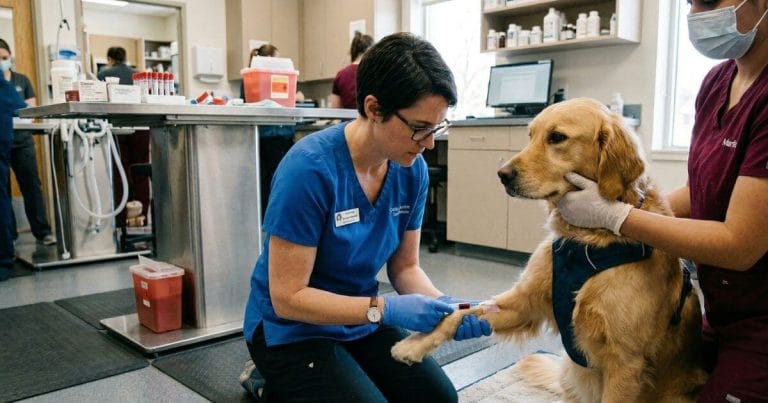
Brucellosis testing is required before every mating. The AKC recommends testing both the stud and the dam within 30 days of breeding. Brucellosis is a bacterial infection transmitted during mating that causes miscarriage, stillbirth, and permanent sterility. There is no reliable cure. If you’re actively studding your dog, plan on testing every 6 months at minimum, and always before a new mating.
The OFA database is your checklist. The Orthopedic Foundation for Animals (OFA) lists the recommended health screenings for every breed. Golden Retrievers need hip, elbow, cardiac, and eye clearances. Bulldogs need cardiac, patella, and tracheal hypoplasia evaluations. Your breed’s parent club determines the requirements, and the OFA makes them searchable. Complete these and publish the results. Having OFA-listed clearances is one of the strongest trust signals a stud owner can offer.
DNA testing adds a competitive edge. Services like Embark screen for 250+ genetic health conditions and calculate a coefficient of inbreeding (COI) score. A low COI means your dog contributes genetic diversity to the breed, which is increasingly important to dam owners concerned about popular sire syndrome, where overused studs narrow the gene pool. Sharing your dog’s Embark results on his profile sets you apart from competitors who only show basic vet clearances.
Keep everything current and documented. Health clearances expire or become outdated. OFA hip evaluations are done once (at 2+ years), but eye exams should be renewed annually. Brucellosis tests need refreshing before each mating. Store all documentation digitally so you can share it instantly when a dam owner enquires. PairMyPet’s health testing page outlines the baseline requirements.
How Much Should I Charge for Stud Service?
Most stud fees range from $250 to $1,000 for standard breeds, with champion-titled or proven studs in popular breeds charging $1,500 to $3,000 or more. A common rule of thumb is to set the stud fee equal to the price of one puppy from the expected litter. Your credentials, health clearances, and track record justify the price point, not just your dog’s appearance.
Factors that increase your fee. According to Dogster’s 2026 stud fee guide, the biggest price drivers are OFA health clearances (reduces the dam owner’s risk), AKC championship or performance titles (proven quality), litter history (healthy puppies from previous matings), and breed demand. A French Bulldog stud in a major metro area will command significantly more than a less popular breed in a rural location.
Stud Fee Structures Compared
Choose the arrangement that works for you
Flat Cash Fee
- Payment upfront or on mating day
- No waiting for litter to be born
- Simple, straightforward transaction
- Covers 2-3 breeding attempts
Pick of Litter
- Potentially higher value than cash
- Great for expanding your program
- No cash changes hands
- Must wait until puppies are born
Hybrid
- Immediate cash plus future puppy
- Reduced risk for both parties
- Flexible negotiation
- Common for high-value studs
Choose your payment structure. Lancaster Puppies’ stud fee guide outlines the main options. A flat cash fee is the most straightforward: the dam owner pays before or on the day of mating, typically covering 2 to 3 breeding attempts. Pick of the litter means you choose first from the resulting puppies, which can be more valuable than cash for high-end breeds. Some stud owners use a hybrid, taking a reduced cash fee plus pick of litter.
Research your competition. Before setting your price, look at what other studs of the same breed in your region are charging. If your dog has stronger credentials (more health clearances, titles, or proven litters), price above average. If he’s unproven, start lower and raise your fee as he builds a track record.
Include a return service guarantee. Most stud contracts include a free repeat breeding on the next heat cycle if the dam doesn’t conceive. This is industry standard and dam owners will expect it. If the second attempt also fails, you’re generally not obligated to refund, but clarify all terms upfront.
How to List Your Stud Dog on PairMyPet
Most stud dog owners still rely on breed club contacts, Facebook groups, or word of mouth to find breeding partners. Those channels work, but they’re slow and offer no way to verify credentials upfront. Dam owners searching online want to see health clearances, pedigree details, and stud fees before they make contact.
PairMyPet was built to solve this for both sides. The platform connects responsible dog (and cat) breeders with health verification and transparent profiles at the core.
Here’s how to list your stud:
From Health Testing to Successful Stud
Complete Health Testing
OFA clearances, DNA panel, brucellosis test
Create Profile
Add photos, pedigree, certifications, fee
Get Verified
Earn trust badge with verified documents
Connect
Message dam owners, discuss compatibility
Mating Day
Signed contract, successful breeding
Step 1: Create your stud’s profile. Add his breed, age, registration details, health testing results (OFA, Embark, brucellosis), pedigree information, photos, stud fee, and any requirements you have for the female (e.g., must be health-tested, must be registered). The more documentation you include, the more enquiries you’ll get from serious breeders.
Step 2: Get verified. PairMyPet’s verified profile system lets dam owners see that your health certifications are real. This is the single biggest differentiator between PairMyPet and generic classifieds where anyone can claim anything.
Step 3: Connect with dam owners. When a dam owner finds your stud in the directory, they message you directly through the platform. Discuss compatibility, timing, logistics, and fees, then move forward with a signed contract.
A well-documented stud profile on a platform that attracts responsible breeders will generate better enquiries than a free Facebook post ever will.
How Do I Prepare for the Mating Day?
The mating should happen at the stud dog’s home, where he’s comfortable and confident. Confirm the dam’s brucellosis test results and heat cycle timing with the owner beforehand. Have your stud contract signed before the dogs meet. Plan for two to three mating sessions spaced 24 to 48 hours apart, and only intervene if absolutely necessary during the natural process.
Pair a first-time stud with an experienced dam. The Revival Animal Health guide recommends that first-time studs be paired with a female who has been bred before. An inexperienced dam may be anxious or skittish, which can discourage a young stud. An experienced female knows the process and helps things go smoothly.
Set up the right environment. A quiet, enclosed space with good footing (no slippery floors) works best. Remove distractions, other dogs, loud noises, and foot traffic. Let the dogs interact naturally and at their own pace. Forced matings are stressful and can create behavioural problems for future breeding attempts.
Know when to consider artificial insemination. If the natural mating fails after multiple attempts, or if the dam is travelling from a distance, artificial insemination (AI) is a viable alternative. Discuss this possibility with the dam’s owner before mating day and include AI terms in your stud contract. PairMyPet’s breeding guide covers both natural and assisted breeding options.
Document everything. Record the dates and outcomes of each mating attempt. This information goes into your stud’s breeding history, which builds his reputation as a proven producer for future enquiries.
Ready to List Your Stud Dog?
Offering stud services is a serious commitment to your breed. Get the health clearances done through the OFA, build your dog’s credentials, set a fair price backed by documentation, and list on a platform that attracts responsible breeders who will value what your dog brings to the table.
Create your stud dog profile on PairMyPet today. Your profile, health certifications, and pedigree details are visible to dam owners searching by breed and location, so the right breeding partners can find you.
From Our Blog

Frequently Asked Questions
How old does my dog need to be before I can stud him out?
Most breed experts and veterinarians recommend waiting until your dog is at least 2 years old. At this age, his skeletal system is fully developed (critical for accurate OFA hip and elbow evaluations), his temperament has stabilised, and his fertility is at peak levels. Small breeds may mature earlier, but completing health clearances at 2 years is standard practice regardless of size. Breeding a dog before his health evaluations are complete puts the resulting puppies at risk.
Do I need kennel club registration to offer stud services?
Technically, no. There is no legal requirement for registration to breed your dog. However, without registration (AKC, UKC, CKC, or equivalent), the puppies cannot be registered either, which significantly reduces their value and makes it much harder to attract responsible dam owners. If your breed is not AKC-recognised, check with alternative registries where it is listed. Registration is a trust signal that serious breeders expect.
What should be in a stud dog contract?
A standard stud contract should cover the stud fee amount and payment terms, how many mating attempts are included (typically 2 to 3), return service terms if the dam doesn’t conceive, whether pick of the litter is part of the arrangement, health testing requirements for both dogs, who covers travel or artificial insemination costs, and registration terms for the resulting litter. Both parties should sign before any mating takes place. According to Revival Animal Health, a written contract eliminates confusion and protects both the stud and dam owners.
How often can I stud my dog out safely?
There is no strict medical limit, but responsible practice is to avoid overusing your stud. Most breed experts recommend no more than one or two matings per month during active breeding periods, with rest periods in between. More importantly, be aware of popular sire syndrome: if your stud fathers too many litters, his DNA becomes overrepresented in the breed population, making it harder to avoid inbreeding in future generations. Embark’s COI tool can help you and dam owners monitor genetic diversity.
What if the mating doesn’t result in pregnancy?
Most stud contracts include a return service clause, giving the dam owner a free repeat breeding on her next heat cycle (typically 6 months later). Some contracts limit this to one return attempt. If the second breeding also fails, the stud fee is generally not refunded. To protect yourself, clearly state the return service terms in your contract before the first mating. If pregnancy failure becomes a pattern across multiple females, have your dog’s fertility evaluated by a veterinary reproductive specialist.
Start Connecting with Dam Owners
Create your verified stud profile and let responsible breeders find you.