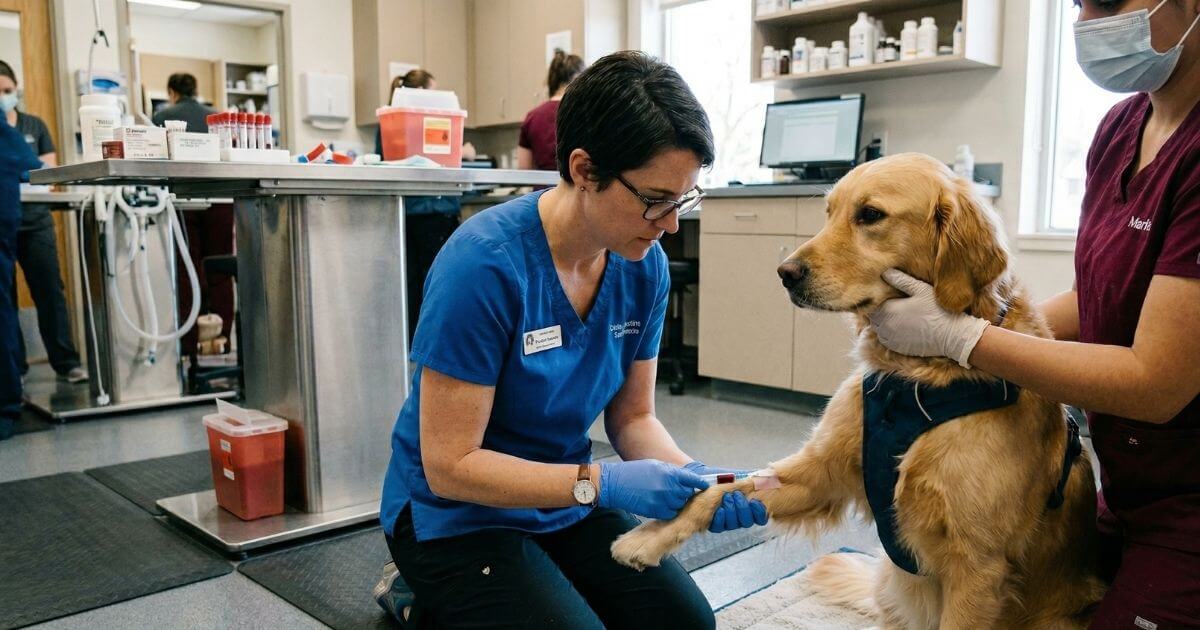
- Progesterone blood tests help estimate ovulation. A series of results tells you more than one reading.
- Contact your vet when heat starts. The first test and follow-up appointments depend on your dog’s cycle.
- Fresh, chilled, and frozen semen need different timing. Use the estimated LH surge and ovulation to plan breeding, rather than a fixed progesterone target.
Your dog has started her heat cycle, and you’re trying to work out when to arrange breeding. The first blood-test result may leave you unsure whether to book another test, arrange a mating, or wait.
Progesterone testing helps answer those questions by following the hormonal changes around ovulation. This guide explains what the results mean, why repeat samples matter, and how the plan changes when you’re using fresh, chilled, or frozen semen.
What Does Progesterone Testing Tell You?
The test measures progesterone, a reproductive hormone, in a small blood sample. Results are commonly reported in nanograms per milliliter (ng/mL). In dogs, progesterone begins rising before ovulation, giving the vet a useful way to follow its approach.
The first rise is associated with a surge in luteinizing hormone, or LH, which triggers ovulation. Repeated progesterone tests help estimate when these events happen. The laboratory method, also called the assay, affects the numbers, so they need to be interpreted as a sequence.
Watching for signs of heat helps you know when to call the clinic. It cannot reliably identify ovulation. Mistimed breeding is an important, preventable cause of conception failure, particularly with shipped semen, although semen quality and reproductive health matter too. UC Davis explains how combining cycle observations and tests improves timing.
When Should You Start Testing?
Call your vet when you first notice swelling or bloody discharge. Note that date, even if you’re unsure when heat actually began. It gives the clinic a starting point for arranging monitoring.
Repeated progesterone testing commonly begins in late proestrus, toward the end of the initial phase of heat. Some vets take an earlier baseline sample and a vaginal swab at the first signs. IDEXX’s testing guidance describes this early baseline approach, followed by closer monitoring as the vaginal cells change.
There isn’t a single best starting day for every dog. Some are still in proestrus on days 5-7; others progress sooner. A previous cycle can provide useful background, but it doesn’t set the timetable for this one.
Once monitoring begins, the results help determine the next appointment:
- At baseline: If progesterone is below about 1 ng/mL, a repeat sample in 2-3 days may be appropriate.
- As the level begins to rise: Testing often moves to every 1-2 days.
- After a clear rise: Follow-up tests help establish whether the rise is continuing and estimate ovulation. Further sampling depends on the breeding plan and assay.
The clinic may shorten these intervals if your dog’s history, examination, or semen type calls for closer monitoring.
How to Read the Progesterone Numbers
Use the ranges below to understand the conversation with your vet. They are approximate associations, not boundaries between stages: dogs vary, and different assays can give different results.
Progesterone Level Reference Guide
Read each result alongside the earlier samples from the same cycle
A repeat sample shows whether the rise continues. Imagine an early sample is low and the next one is higher. That suggests the cycle is progressing, but it leaves uncertainty about when the rise started and what happens next. Another sample shows whether the increase continues. That’s what makes the sequence useful for estimating ovulation.
The ranges overlap. A result below 2 ng/mL, for example, doesn’t automatically mean the LH-associated rise hasn’t started. Merck emphasizes that no single progesterone value identifies a particular stage. Equally, a high reading alone cannot tell you that the breeding window has closed.
Why Ovulation Day and Breeding Day Can Differ
Dog eggs are released before they are ready to be fertilized. These immature eggs, called primary oocytes, need approximately 2-3 days after ovulation to mature. They then remain capable of fertilization for approximately another 2-3 days.
This explains why breeding isn’t simply a matter of catching ovulation. Sperm need to be alive when mature eggs are available. Fresh sperm can survive for several days, sometimes beyond seven days in favorable conditions. Chilled and frozen semen have shorter survival times, leaving less room for a timing error.
Breeding schedules often use the LH surge as day 0. Ovulation follows within a few days: UC Davis describes about 1-2 days after the surge, while Merck describes 2-3 days after the LH peak. These descriptions are useful guides, but the tests still need to establish how your own dog’s cycle is progressing.
How Semen Type Changes the Breeding Plan
The comparison below shows typical schedules described in Merck’s breeding guidance. They are based on the estimated LH surge rather than a universal progesterone target. Semen quality, handling, and the method of insemination also affect the schedule.
Breeding Timing by Semen Type
Typical schedules after the estimated LH surge; semen quality and insemination method affect the plan
May exceed 7 days in favorable conditions
Depends on protocol and semen handling
Requires close veterinary monitoring
For a natural mating or fresh semen insemination, the longer sperm survival gives you more flexibility. If two breedings are planned, agree on their spacing with the clinic and the stud owner.
For chilled semen, coordinate collection, delivery, and the insemination appointment together. Let both clinics know the latest results before confirming shipment. The useful window depends partly on the semen’s quality and handling history.
For frozen semen, arrange testing and insemination with a reproductive vet before the expected window. Its short survival after thawing makes close monitoring especially valuable. Serial progesterone testing is strongly recommended, and LH testing or other examinations may help refine the timing.
Choosing a Testing Service
A useful result needs to arrive in time to act on it. Ask whether samples are tested at the clinic or sent away, when results are usually available, and what happens if you need a test over the weekend.
Testing Method Comparison
Compare how results are reported and when they will be available
Reference Laboratory
In-House Quantitative
Semi-Quantitative ELISA
For the series of blood tests, use the same laboratory or analyzer where possible. Results from different platforms aren’t interchangeable: one may read higher or lower than another, without a reliable universal conversion. If you need to change clinics, bring the full reports so the vet can see which method produced each result.
Automated quantitative tests can be useful for breeding management, but a brand name alone doesn’t establish suitability. Manufacturers compare assays with a reference method during validation; for example, IDEXX describes using liquid chromatography-mass spectrometry (LC-MS). For your appointment, the practical questions are whether the test is suitable for canine reproductive monitoring and how promptly the clinic can interpret it.
Why Your Vet May Recommend Other Tests
A blood result is easier to interpret when it fits the other signs of the cycle. UC Davis describes several complementary checks:
- Vaginal cytology: Cells collected on a swab are examined under a microscope. Their changing appearance reflects estrogen’s effects on the vaginal lining and helps identify the transition into estrus. It doesn’t directly measure estrogen, prove a peak, or pinpoint ovulation.
- LH testing: This measures the surge directly, providing a firmer day-zero reference. Daily sampling is usually needed because the surge can be brief.
- Vaginoscopy: A scope allows the vet to examine changes in the folds of the vaginal lining, adding information about the cycle’s progress.
What to Prepare Before the First Appointment
You don’t need to interpret the lab report yourself to help the process run smoothly. Bring the details that let the clinic plan around your dog and the proposed breeding:
- Cycle records: When you first noticed heat, any previous timing results, and a history of missed breedings or unusual cycles.
- The breeding arrangements: Whether you plan to use fresh, chilled, or frozen semen, who will supply it, and any travel or shipping constraints.
- A way to keep results together: Save each report with its collection date, time, units, and laboratory or analyzer. Bring the reports if more than one clinic is involved.
- A follow-up plan: Confirm how you’ll receive results, when to book the next sample, and whom to contact if the timing changes over a weekend.
Breeding readiness also includes your dog’s age and overall health. Complete the relevant pre-breeding health checks before trying to time a mating.
Estimating the Whelping Date
An estimated ovulation date gives a more reliable starting point than the mating date, especially when breedings took place on several days. Gestation is approximately 63 days from ovulation, or 64-66 days from the LH surge, with some individual variation.
That information helps with delivery planning, particularly for dogs with a history of difficult births. It doesn’t establish readiness for a cesarean section on its own.
Later in pregnancy, progesterone falls as birth approaches. Research on this decline shows why the assay matters when interpreting late-pregnancy results. The hormone level can support a delivery assessment, but decisions about a C-section also require clinical signs, fetal viability, and veterinary assessment. A single cutoff cannot guarantee a safe delivery or a birth within a set number of hours.
Planning a Breeding?
Find a potential breeding partner on PairMyPet, then discuss health screening and timing with your veterinarian.
Browse Stud Dogs Breeding Match FinderLast updated: September 2026
Frequently Asked Questions
How much does progesterone testing cost for dogs?
Ask for a quote that includes the consultation, blood collection, and test itself. The total depends on how many samples are needed. For a simple budgeting example, five tests at $100 each would cost $500 before any separate fees. Use your clinic’s prices and expected testing plan to work out your own budget.
Can you do progesterone testing at home?
Some kits marketed for home use estimate broad ranges through a color change. They do not provide the precision of a quantitative laboratory or in-clinic test. Discuss any kit with your vet before relying on it; chilled and frozen semen breeding needs more precise monitoring.
How many progesterone tests will my dog need per cycle?
There is no fixed number. It depends on when testing begins, how quickly the results change, and the breeding plan. Irregular or split heats may need more monitoring. Ask the clinic for an initial estimate and expect it to be revised as results come in. Vaginal cytology can help identify when blood testing will be most useful.
What happens if breeding is timed too early or too late?
If breeding is too early, sperm may no longer be viable when the eggs mature. Too late, and the eggs may no longer be capable of fertilization. Both can reduce the chance of conception. A high or low progesterone result alone cannot establish either limit, and a missed breeding does not by itself mean your dog is infertile.
Should I use progesterone testing for every breeding?
It is strongly recommended as part of breeding management, even if your dog has had a litter before. Ovulation timing can change between cycles. Testing is particularly useful for shipped semen, limited mating opportunities, or a history of missed breedings. The monitoring plan should fit the dog and the semen being used.