Up to 75 percent of failed breedings come down to the wrong day, not the wrong dog. That’s where artificial insemination in dogs earns its place. It hands breeders control over the two things natural mating can’t fix: distance between studs and dams, and the narrow window when conception actually works.
This guide compares fresh, chilled, and frozen semen on success rate, cost, and logistics. You’ll learn which insemination method your vet should pick, what timing to demand, the real 2026 price tag, and which surgical procedures are no longer legal. By the end, you’ll know whether AI is right for your next litter and how to set it up so it works the first time.
About this guide: The procedures, costs, and AKC paperwork covered here reflect US-based veterinary practice. Surgical artificial insemination is banned or being phased out in the UK, Norway, Sweden, the Netherlands, and Australian greyhound racing from 2026. Always check the rules in your jurisdiction and confirm protocols with a reproduction-focused vet before booking a breeding.
- Fresh semen has the highest success rates (62 to 100 percent) and the longest viability inside the dam (5 to 7 days)
- Chilled semen ships overnight and stays viable 24 to 72 hours, making it the standard for non-local matings
- Frozen semen has indefinite shelf life in liquid nitrogen but only 12 to 24 hours of usable life once thawed
- Transcervical insemination (TCI) matches surgical AI on whelping rate without anaesthesia, and is the modern default method
- Up to 75 percent of failed breedings trace to incorrect timing, not infertility, so progesterone testing is non-negotiable
- Total cost runs $300 to $1,200 for the procedure alone, with a realistic chilled-semen breeding totalling around $2,050 per attempt
- AKC requires DNA Certification of the sire before semen is collected for storage or shipping (rule in force since October 1998)
Why Artificial Insemination Has Become Standard in Modern Dog Breeding
Artificial insemination is no longer a niche technique. Most reputable breeders now use it for at least some matings, and the BVA and BSAVA 2023 position on canine breeding services treats well-executed AI as standard veterinary practice.
Three forces drove the shift. First, frozen-semen technology lets breeders use a sire who lives on another continent or who died a decade ago, opening up genetic diversity that closed gene pools desperately need. Second, behavioural mismatch is real: even when both dogs are fertile, some pairings won’t tie naturally. Third, shipping a vial of semen overnight is cheaper, safer, and less stressful than flying a dam across the country.
Natural mating still wins on cost and simplicity when both dogs are local and willing. But for cross-country matings, repeat breedings to an older sire, or working with a sub-fertile pair, AI is often the only practical path. For the broader process around choosing a mate and preparing for breeding, see our full dog breeding guide.
How Does Artificial Insemination in Dogs Work?
Artificial insemination in dogs is the veterinary procedure of collecting semen from a stud and placing it into the female’s reproductive tract instead of natural mating. It happens in four stages: progesterone-timed ovulation tracking, semen collection from the stud, processing (fresh, chilled, or thawed from frozen), and deposition into the vagina, cervix, or uterus.
The order is the same regardless of semen type. What changes is the timing of each step, the equipment needed, and which insemination method your vet selects at stage four.
The 4 Stages of Canine Artificial Insemination
From the dam’s heat cycle to confirmed deposition
The collection in stage 2 sometimes happens at a completely different clinic from the deposition in stage 4. According to Revival Animal Health, that’s normal for chilled and frozen breedings: the stud’s vet collects and processes, the dam’s vet handles insemination.
What’s the Difference Between Fresh, Chilled, and Frozen Semen?
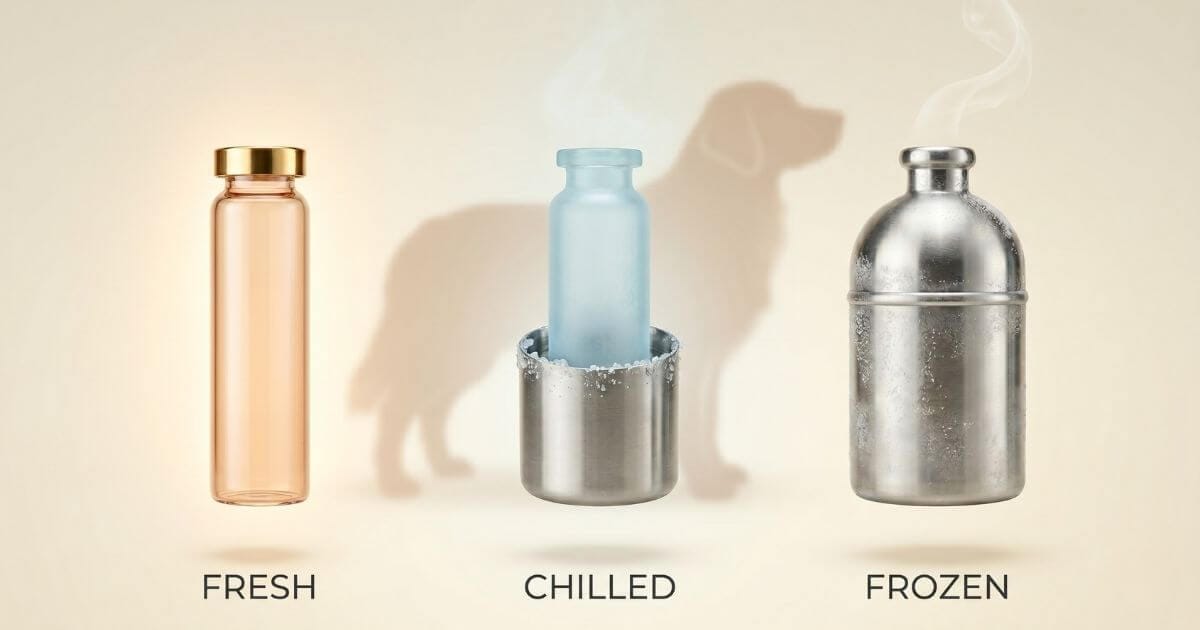
Fresh semen is used within minutes of collection and survives 5 to 7 days inside the dam. Chilled semen is diluted in egg-yolk extender, stored at 4°C, and stays viable 24 to 72 hours, perfect for overnight shipping. Frozen semen is cryopreserved in liquid nitrogen with indefinite shelf life, but only 12 to 24 hours of usable life once thawed.
The choice between the three comes down to four practical factors: where the stud lives, how much you’re willing to spend, the dam’s fertility, and your tolerance for a missed cycle.
Fresh vs Chilled vs Frozen: Which Semen Type to Choose
Compare viability, logistics, and best use case at a glance
Fresh
Same-day use- Viability in dam
- 5 to 7 days
- Best-method success
- 62 to 100%
- Shipping
- Not possible
- AKC DNA cert
- Not required
Chilled
Overnight shipping- Viability in dam
- 24 to 72 hours
- Best-method success
- 59 to 80%
- Shipping
- FedEx/UPS overnight
- AKC DNA cert
- Required if shipped
Frozen
Indefinite storage- Viability in dam
- 12 to 24 hours
- Best-method success
- 50 to 80%
- Shipping
- International, any time
- AKC DNA cert
- Required (since Oct 1998)
Fresh wins on every metric that matters except logistics. If your stud lives within driving distance and is willing to mate within a 48-hour window, fresh is the obvious choice. The downside: you’re committed to one cycle and one location.
Chilled is the workhorse of modern dog breeding. The stud’s vet collects, processes, and ships the semen in an Equitainer or Breeder Box packed with cold packs at 4 to 5°C, FedEx overnight to the dam’s vet. Most matings using a non-local sire run on chilled. If you’re still sourcing a stud, our guide on how to find a stud dog walks through what to ask about semen handling experience before booking.
Frozen unlocks genetics natural mating can’t reach: a champion sire on another continent, a sire who died years ago, or a stud you want to use across multiple bitches and years. The trade-off is the shorter viability window after thaw, which makes progesterone timing critical and usually rules out vaginal deposition. AKC requires the stud to be DNA Certified before semen is collected for storage, a rule that applies to any collection after October 1998.
Which Insemination Method Has the Best Success Rate?
Transcervical insemination (TCI) gives the best balance of success rate and welfare. A Colorado State Veterinary Teaching Hospital overview puts whelping rates with TCI on par with surgical AI, and TCI needs no anaesthesia. Vaginal insemination works for fresh and chilled semen (50 to 70 percent pregnancy rate); frozen semen needs TCI or surgical placement to clear 50 percent.
The three methods compared
Vaginal insemination is the simplest. Your vet inserts a pipette through the vagina and deposits semen near the cervix while the dam stands in a “show stack.” It works well for high-quality fresh or chilled semen in a fertile dam. According to Kokopelli Veterinary Center, vaginal AI isn’t recommended for frozen semen because the shorter sperm lifespan can’t survive the slow journey from vagina to oviduct.
Transcervical insemination (TCI) uses an endoscope and catheter to pass through the cervix and deposit semen directly into the uterus. It happens with the dam standing, no anaesthesia, and works for fresh, chilled, and frozen semen. A nine-year New Zealand study of 1,146 dogs published in the Australian Veterinary Journal found no difference in whelping rate between TCI and surgical AI. TCI requires a vet trained in the technique and the right endoscopic kit, so not every clinic offers it.
Surgical insemination involves general anaesthesia and a small abdominal incision so the vet can inject semen directly into the uterine horns. Historically used for frozen semen, it’s been largely replaced by TCI in countries where TCI is available. We cover its legal status below.
Success Rates by Method and Semen Type
Pregnancy and whelping rate ranges from peer-reviewed canine reproduction data
The pattern is clear: method matters most for frozen semen, and TCI is usually the right call when it’s available.
When Is the Right Time to Inseminate Based on Progesterone Levels?
Inseminate 2 days after ovulation for chilled semen (progesterone around 20 ng/mL) and 3 to 4 days after for frozen, because thawed sperm only lives 12 to 24 hours. Start progesterone testing on day 6 or 7 of the dam’s heat cycle and repeat every 2 to 3 days until ovulation is confirmed at 5 to 8 ng/mL.
Why timing trumps everything else
The Merck Veterinary Manual attributes up to 75 percent of failed canine breedings to incorrect timing, not infertility. With natural breeding, the dam often corrects for this by accepting the stud across multiple days. AI doesn’t get that luxury: most breeders pay for one or two inseminations, so each one has to land inside the fertile window.
Vet handshake: If your vet is willing to AI without a recent progesterone reading, push back or find another vet. Progesterone is the only reliable signal. Vaginal cytology and behaviour can mislead you. For the full walk-through, see our guide to progesterone testing for breeding timing, and the companion piece on signs your dog is ready to mate for the behavioural cues that tell you when to start testing.
The progesterone landmarks for AI are straightforward: pre-LH surge sits below 2 ng/mL, the surge itself is around 2 ng/mL, ovulation lands at 5 to 8 ng/mL, eggs mature at 10 to 20 ng/mL, and the optimal AI window for chilled or frozen opens once you cross 20 ng/mL. These ranges come from the AKC progesterone testing guide and IDEXX’s clinical reference.
How Much Does Artificial Insemination Cost for a Dog in 2026?
AI for a dog costs $300 to $1,200 in 2026 depending on method. Vaginal and transcervical run $250 to $700; surgical runs $700 to $1,200 where it’s still legal. Add roughly $125 per progesterone test (you’ll need 3 to 5), $300 per dog for pre-breeding health workups, plus $150 to $300 each for semen collection and overnight shipping.
What a Chilled-Semen Breeding Actually Costs
Worked example: dam in California, sire 1,500 miles away, TCI deposition
If the first attempt misses, add roughly $750 for a second insemination (the health workup is one-and-done per cycle). Stud fees are not included and range $500 to $5,000 depending on breed and lineage.
Where breeders get blindsided
- Long-term frozen storage fees at $100 to $200 per year per straw, indefinitely
- Repeat AI attempts if progesterone tracking missed the window
- Mileage to a TCI-equipped clinic if your regular vet doesn’t offer it
- Stud fees, which are not included above and can range $500 to $5,000 depending on breed and lineage
Ethics, Legality, and AKC Registration: What Every Breeder Should Know in 2026
This is where AI gets contentious. The biggest shift in the last five years is the move away from surgical AI in countries with strong animal welfare law.
Surgical AI is banned or being phased out in much of the world
The UK has prohibited surgical AI in dogs since 2019 under the Animal Welfare Act, with Norway, Sweden, and the Netherlands following. The Australian Veterinary Association is pushing for an Australia-wide ban, and Greyhounds Australasia announced the racing industry will end the practice from 2026. In a 2022 European survey of 83 reproduction-focused vets, over 62 percent said surgical insemination isn’t ethical.
The argument is straightforward. TCI achieves the same result without abdominal surgery and without general anaesthesia. The 1,146-dog New Zealand study cited earlier showed no whelping-rate advantage for surgical AI. When two methods produce the same outcome and one cuts the dam open, the ethics draw themselves. For a deeper look at where AI fits inside an ethical breeding programme, see our piece on responsible breeding standards.
In the US, surgical AI remains legal in most states, but the responsible position is to use it only when TCI has been tried and failed, or when no TCI-trained vet is reasonably accessible.
AKC paperwork for AI litters
The AKC registers AI litters like any other litter, with extra paperwork for stored or shipped semen.
If the semen was collected and used in the same session (both dogs present), no extra steps. If the semen was collected for storage or shipping after October 1, 1998, the sire must be AKC DNA Certified before collection. You’ll also need an AKC Frozen Semen Collection Statement on file from the collecting vet.
For frozen-semen litters, the litter registration form requires attestation from the semen owner, the dam owner, and the performing veterinarian. The vet must be licensed in the state where the AI took place.
Bottom line: Get the DNA cert done before semen collection, not after. Retroactive DNA certification won’t help if the AKC won’t accept the paperwork.
Find a Vetted Stud Dog for Your Next Breeding
PairMyPet connects responsible breeders with health-tested, verified stud dogs across the US, UK, Canada, and Australia. Browse by breed, location, and health clearances, then message owners directly to discuss semen handling and AI timing.
Browse Stud DogsFinal Thoughts
Three things separate breeders who get AI right from those who waste $2,000 on a missed cycle. First, pick semen type by access, not prestige: fresh-or-chilled beats frozen when both are options. Second, ask for TCI by default, and reserve surgical AI for the narrow cases where it’s both legal and clinically warranted. Third, treat progesterone testing as non-negotiable, because timing is the single biggest predictor of conception.
If you’re still matching a sire to your dam, our complete breeding guide covers the steps before the vet appointment, and our verified stud listings let you discuss health clearances, semen-handling experience, and AI timing with owners before you book the procedure.
Frequently Asked Questions
You can perform vaginal AI on a dog at home using a fresh sample and a sterile pipette, and some experienced breeders do. Success rates without progesterone testing are noticeably lower, though, and any AI involving frozen semen must be performed by a licensed veterinarian if you want to register the litter with the AKC.
Most vets recommend two inseminations per cycle, 24 to 48 hours apart, to widen the chance of catching the fertile window. With well-timed chilled or frozen semen and confirmed ovulation via progesterone, a single insemination often works. If the first AI misses, a repeat attempt on the same cycle is still worth trying within 48 hours.
Properly cryopreserved canine semen stored in liquid nitrogen has an indefinite shelf life. Samples successfully used for AI after 30+ years of storage have been documented. The risk is in handling: any thaw-and-refreeze cycle, contamination, or interruption of the liquid-nitrogen supply will kill the sample. Use a reputable canine semen bank with backup systems.
With fresh or chilled semen, TCI deposition, and accurate progesterone timing, first-try pregnancy rates run 70 to 80 percent. With frozen semen the first-try rate drops to roughly 50 to 70 percent depending on semen quality and method. Without progesterone testing, success rates fall sharply because most failures trace back to wrong-day insemination.
In the UK, only a licensed veterinarian can perform AI on dogs. In the US, AI isn’t federally regulated, so breeders can legally perform vaginal AI at home in most states. AKC, however, requires a licensed vet to perform frozen-semen AI for the litter to be registerable. TCI and surgical AI always require a vet in every jurisdiction.
Last updated: May 2026