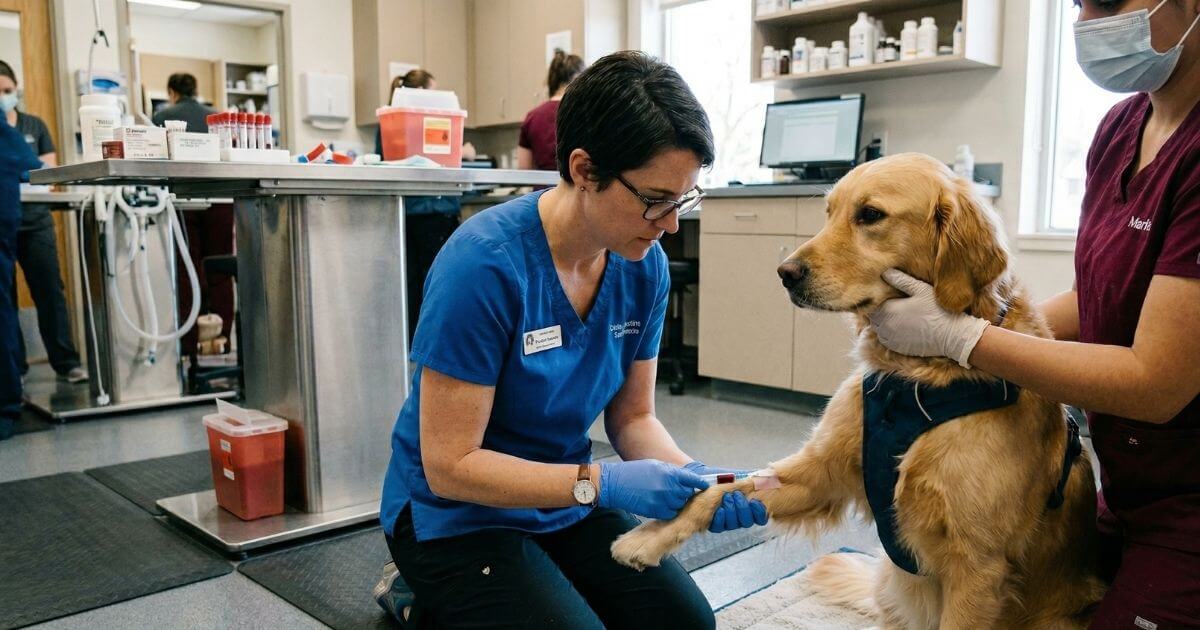
- Progesterone testing is a simple blood test that tracks the hormonal rise leading to ovulation, giving you a precise breeding window instead of guesswork
- The numbers tell you everything: baseline levels below 2 ng/mL mean “not yet,” a rise to 2-3 ng/mL signals the LH surge, 5-8 ng/mL confirms ovulation, and 10-40 ng/mL is your optimal breeding window
- The right time to breed depends on your semen type, and getting it wrong is the most common reason breedings fail
Progesterone testing for dog breeding is the single most reliable method for determining when your dog is ready to mate. Yet mistimed ovulation remains the number one reason breedings fail, according to the American Kennel Club. Not poor semen quality. Not health issues. Simply breeding on the wrong day.
The problem is that most breeders still rely on counting days from the first sign of bleeding or watching for behavioral cues like flagging. These methods can work, but they are unreliable. Some dogs ovulate on day 10 of their heat cycle. Others ovulate on day 22. Without progesterone data, you are guessing, and guessing with frozen semen or a stud dog who lives across the country is an expensive gamble.
This guide walks you through exactly how progesterone testing works, what every number on your results sheet means, and how to act on those numbers based on whether you are using fresh, chilled, or frozen semen. If you have ever stared at a lab report and wondered whether it was time to breed, this is your reference.
What Is Progesterone Testing and Why Do Breeders Need It?
Progesterone testing is a blood test that measures the concentration of progesterone, a reproductive hormone, in your dog’s blood during her heat cycle. The results, reported in nanograms per milliliter (ng/mL), tell you exactly where she is in her estrous cycle and when ovulation is occurring. Breeders need it because mistimed ovulation, not semen quality or health problems, is the leading cause of failed breedings.
Here is why this matters more than most breeders realize. Unlike humans and most other mammals, dogs have a unique reproductive quirk: their progesterone levels begin rising before ovulation, not after. This pre-ovulatory rise is what makes the test so useful.
By tracking the climb from baseline through the luteinizing hormone (LH) surge and into ovulation, you can pinpoint the fertile window with a precision that behavioral observation simply cannot match.
Relying on signs your dog is in heat alone, such as vulvar swelling, flagging, or a change in discharge color, tells you that estrus is happening. It does not tell you when within estrus ovulation occurs. That distinction is the difference between a successful breeding and a missed cycle.
The AKC Canine Health Foundation emphasizes that quantitative progesterone measurement is the gold standard for ovulation timing in dogs, particularly when using artificial insemination or working with shipped semen where timing precision is non-negotiable.
When Should You Start Progesterone Testing During a Heat Cycle?
Start progesterone testing between day 5 and day 7 of your dog’s heat cycle, then retest every 2 to 3 days until you see the initial rise that signals the LH surge. Once that rise begins, switch to testing every 24 to 48 hours to catch ovulation in real time. Most dogs need 4 to 7 total blood draws per cycle.
The first sign of heat (proestrus) is typically vulvar swelling and bloody discharge. Day 1 is the first day you notice these signs. By days 5 to 7, most dogs are still in early proestrus with baseline progesterone below 1 ng/mL. Starting here gives you a reliable baseline reading and enough lead time to catch the LH surge before ovulation.
Why not start earlier or later? Earlier testing wastes money on results that will all read baseline. Starting later risks missing the initial progesterone rise entirely, especially in dogs who ovulate early in their cycle. Some breeds and individual dogs are notorious for irregular timing, which is exactly why the best age to breed your dog should factor in her cycle history.
A common testing schedule looks like this:
- Day 5-7: First blood draw. Expect baseline (below 1.0 ng/mL).
- Day 7-9: Second draw. Still likely baseline, but you are watching for movement.
- Day 9-11: Third draw. If progesterone has risen to 1.5-2.5 ng/mL, the LH surge is happening.
- Day 11-13: Confirm ovulation with a level of 5 ng/mL or above.
- Day 13-15: Verify the breeding window by checking that levels continue rising.
This is a general framework. Your dog’s individual cycle may compress or stretch this timeline significantly. The numbers on the lab report, not the calendar, should drive every decision.
What Do the Numbers Mean? A Progesterone Level Reference Guide
Progesterone levels below 2 ng/mL mean your dog has not yet reached the LH surge and ovulation is at least 2 to 3 days away. Levels of 2 to 3 ng/mL indicate the LH surge is occurring. Levels of 5 to 8 ng/mL confirm ovulation has happened. Levels of 10 to 40 ng/mL signal the optimal breeding window when eggs are mature and ready for fertilization.
Here is what each range means and what you should do at each stage.
Progesterone Level Reference Guide
What your numbers mean and what to do at each stage
Baseline (below 1.0 ng/mL). Your dog is in proestrus or early estrus. The ovaries are developing follicles but have not yet signaled for ovulation. No action needed beyond scheduling your next test in 2 to 3 days.
Initial rise to 1.5-2.5 ng/mL. This is the critical inflection point. The Merck Veterinary Manual identifies this initial rise as correlating with the LH surge, which is the hormonal trigger for ovulation.
The LH surge itself lasts only about 24 hours in most dogs, making it easy to miss if you are not testing frequently. Once you see this rise, ovulation will follow in approximately 2 days.
Pre-ovulatory rise to 3-4 ng/mL. Progesterone continues climbing. The ovarian follicles are preparing to release eggs. Breed in 3 to 5 days if using fresh semen. For chilled or frozen, continue monitoring.
Ovulation at 5-8 ng/mL. Eggs have been released from the ovaries. But here is the detail most articles gloss over: canine oocytes are not immediately fertilizable at ovulation. Unlike most species, dog eggs are released as primary oocytes and require another 48 hours to mature into secondary oocytes that sperm can actually penetrate.
This maturation window is why breeding on the day of ovulation is often too early for anything other than fresh semen with its longer lifespan.
Optimal window at 10-20 ng/mL. Eggs are mature. This is the prime breeding window for all semen types. Health testing before breeding should already be complete by this point, so your focus is entirely on timing.
Late window at 20-40+ ng/mL. Eggs remain viable but the window is closing. For fresh semen, you likely still have time. For frozen semen, you may already be late.
How Does Semen Type Affect Your Breeding Timing?
Fresh semen survives 5 to 6 days in the uterus, giving you a wide breeding window. Chilled semen lasts 24 to 72 hours. Frozen semen survives just 12 to 24 hours after thawing. Your progesterone target and breeding day must match the semen type, because the window for frozen semen is measured in hours, not days.
This is the part of progesterone testing that separates a well-timed breeding from a missed opportunity. The numbers on your lab report do not exist in isolation. They only become actionable when you pair them with the lifespan of the semen you are working with.
Breeding Timing by Semen Type
Match your progesterone numbers to semen lifespan for optimal timing
(2-3 days post-ovulation)
(3-4 days post-ovulation)
Fresh semen (natural breeding or vaginal AI). With a 5 to 6 day survival window, fresh semen is the most forgiving. You can breed when progesterone reaches 5 to 10 ng/mL, which corresponds to ovulation day or shortly after.
The Merck Veterinary Manual recommends natural breedings or fresh semen insemination between days 3 and 6 after the LH surge, with two breedings spaced 48 hours apart as a standard protocol.
Fresh chilled semen (shipped). Chilled semen has a shorter lifespan of 24 to 72 hours once warmed to body temperature. You need to wait until progesterone reaches 10 to 15 ng/mL, confirming that eggs are already maturing.
The Merck Veterinary Manual advises breeding with chilled semen on days 4 and 6 (or days 3 and 5) post-LH surge. Coordinate your semen shipment based on progesterone trends so it arrives when you need it, not a day late.
Frozen-thawed semen (surgical AI or transcervical insemination). Frozen semen survives only 12 to 24 hours. There is almost no margin for error. Purina Pro Club cites a target around 15 ng/mL or higher, with insemination on days 5 to 6 post-LH surge.
This is 3 to 4 days after ovulation, when eggs are fully mature and the sperm’s brief window aligns with peak fertility. If you are finding the right stud dog and the arrangement involves shipped frozen semen, progesterone testing is not optional. It is the only way to justify the cost and logistics.
In-House vs. Laboratory Testing: Which Should You Trust?
Not all progesterone numbers are created equal. The machine your veterinarian uses to run the test will affect the number on your report, sometimes significantly. Understanding this is essential to interpreting results correctly.
There are three broad categories of progesterone testing available to breeders.
Quantitative laboratory assays (reference labs). Your vet draws blood and sends the sample to an external laboratory, typically running a chemiluminescent immunoassay (CMIA) on machines like the Immulite or Tosoh. This is the gold standard for accuracy. Results take 24 to 72 hours, which can be a problem when you are trying to catch a fast-moving cycle.
Quantitative in-house analyzers. Many reproductive veterinarians have invested in machines like the IDEXX Catalyst, Mini VIDAS, or other in-clinic analyzers that return results in under an hour. IDEXX selected liquid chromatography-mass spectrometry (LC-MS) as their reference calibration method due to its superior specificity for steroid hormones. These machines are accurate, but their numbers may not match a reference lab exactly.
Semi-quantitative ELISA kits. Rapid test kits that give a color-change result rather than a precise number. These can indicate whether progesterone is low, medium, or high, but they lack the resolution needed for precise breeding timing, especially with frozen semen.
Testing Method Comparison
Choose the right testing approach for your breeding situation
Reference Lab (CMIA)
In-House Quantitative
Semi-Quantitative ELISA
Here is the critical takeaway: a progesterone reading of 5 ng/mL on one machine may read as 6.5 ng/mL on another. A peer-reviewed study published in the Canadian Veterinary Journal found strong correlation between in-house and reference methods (R² = 0.90), but noted that in-house analyzers consistently read slightly higher than CMIA at pre-ovulatory levels below 4 ng/mL.
Well Bred Vet identifies the Immulite, Tosoh, and Mini VIDAS as the most accurate in-house options because they minimize human operator involvement, which is the largest source of error.
The practical recommendation: track each cycle on the same machine from start to finish. Do not compare a Monday reading from one analyzer to a Wednesday reading from a different one. The trend matters more than any single absolute number.
Pro tip: If you are doing a frozen semen breeding where timing is measured in hours, consider confirming your in-house result with a reference lab draw on the day you believe ovulation is occurring.
Beyond Progesterone: Complementary Tools for Breeding Timing
Progesterone testing is the cornerstone, but board-certified theriogenologists rarely rely on it alone. Combining progesterone data with other diagnostic tools increases confidence in your timing, especially for high-stakes breedings.
Vaginal cytology. A simple, inexpensive swab of the vaginal lining that is examined under a microscope. The Merck Veterinary Manual describes it as the simplest and most widely used diagnostic tool for staging the estrous cycle. During peak estrus, the cells become large, flat, and cornified (described as looking like corn flakes under the microscope).
Cytology tells you that estrogen has peaked and estrus is underway, but it cannot tell you the exact day of ovulation. Use it to confirm that your progesterone timing aligns with the expected cellular changes.
LH testing. A separate blood test that detects the LH surge directly. Since the LH surge lasts only about 24 hours, it requires daily blood draws to catch, making it impractical as a standalone method.
However, when caught, it provides the most precise “day zero” reference point. Ovulation follows 2 days later, and whelping follows 65 days after the LH surge with remarkable consistency.
Vaginoscopy. A visual examination of the vaginal lining using a scope. Changes in the mucosal folds (crenulation) correlate with estrogen levels and can confirm the transition from proestrus to estrus. Dr. Bruce Christensen, a board-certified theriogenologist at Kokopelli Assisted Reproductive Services, uses vaginoscopy alongside progesterone and cytology for the most comprehensive picture of cycle stage.
For a complete overview of what screening should happen before any breeding, review the complete health testing checklist to ensure you are covering genetic, orthopedic, and cardiac evaluations in addition to reproductive timing.
How Does Progesterone Testing Predict Your Whelping Date?
Whelping occurs approximately 63 days after ovulation, plus or minus 24 hours. Because progesterone testing pinpoints the ovulation date, it gives you the most accurate due date prediction available. Counting from the breeding date is unreliable because breedings can span multiple days, but ovulation happens once, and gestation from that point is remarkably consistent.
This is one of progesterone testing’s most underappreciated benefits. Breeding dates can vary by several days depending on semen type and how many inseminations were performed. Gestation length from ovulation, however, is remarkably consistent at 63 days with a variance of plus or minus one day.
For brachycephalic breeds (English Bulldogs, French Bulldogs, Boston Terriers) or any dog with a history of dystocia, knowing the ovulation date allows your veterinarian to schedule an elective cesarean section with confidence.
Research published in Frontiers in Veterinary Science found that when progesterone drops below 2.8 ng/mL in late pregnancy, there is a 99% probability the dog will whelp within 48 hours. A drop below 1.0 ng/mL makes whelping within 48 hours virtually certain.
This late-pregnancy progesterone monitoring is separate from your breeding-timing tests, but it uses the same hormone and the same type of blood draw. If you tracked ovulation with progesterone, you already have the data your vet needs to plan a safe delivery.
Conclusion
Progesterone testing transforms dog breeding from guesswork into a data-driven process. The investment of a few hundred dollars across 4 to 7 blood draws per cycle is small compared to the cost of a missed breeding, a failed litter, or an emergency C-section scheduled too early or too late.
The key principles are straightforward: start testing by day 5 to 7 of heat, watch for the initial rise to 2 to 3 ng/mL that signals the LH surge, confirm ovulation at 5 to 8 ng/mL, and time your breeding based on your semen type. Use the same testing machine throughout the cycle, and do not hesitate to combine progesterone with cytology or vaginoscopy for high-stakes breedings.
Find a Health-Tested Breeding Partner
Ready to connect with responsible breeders? Browse stud dogs on PairMyPet or use the breeding match finder to find the right pairing.
Browse Stud Dogs Breeding Match FinderIf you are ready to find a health-tested breeding partner, browse stud dogs on PairMyPet or use the breeding match finder to connect with responsible owners who take timing as seriously as you do.
Last updated: April 2026
Frequently Asked Questions
Most veterinary clinics charge between $100 and $120 per progesterone blood draw, according to the AKC. A typical heat cycle requires 4 to 7 tests, putting total costs between $400 and $840. Reproductive specialty clinics may charge more but often use higher-precision analyzers. The cost is significantly less than a failed breeding or a repeat semen shipment.
Semi-quantitative test kits marketed for home use do exist, but they provide only broad ranges (low, medium, high) rather than precise ng/mL readings. For natural breedings with fresh semen, a home kit can indicate when to schedule a veterinary blood draw. For chilled or frozen semen breedings, home kits lack the precision needed to time insemination accurately. A quantitative test from your vet is always recommended for critical breeding decisions.
Plan for 4 to 7 tests per cycle. Dogs with predictable cycles who respond quickly may need as few as 3 to 4 draws. Dogs with irregular cycles, split heats, or silent heats can require 7 or more. Starting vaginal cytology before progesterone testing can help you identify the optimal window to begin blood draws, potentially reducing the total number of tests needed.
Breeding too early (before ovulation at 5 ng/mL) means the eggs have not been released yet. Fresh semen may survive long enough, but chilled and frozen semen will likely expire before the eggs mature. Breeding too late (above 30 to 40 ng/mL) means the eggs have begun to degenerate. Both scenarios result in reduced conception rates or complete breeding failure, which is the leading cause of infertility in otherwise healthy dogs.
Yes. Even experienced breeders with dogs who have whelped before benefit from progesterone testing every cycle. Individual dogs can shift their ovulation timing from one cycle to the next, and what worked last time is not guaranteed to work again. Testing is especially critical for first-time dams, breedings involving shipped semen, dogs over 5 years old, and any pairing where the genetic combination is particularly valuable.