
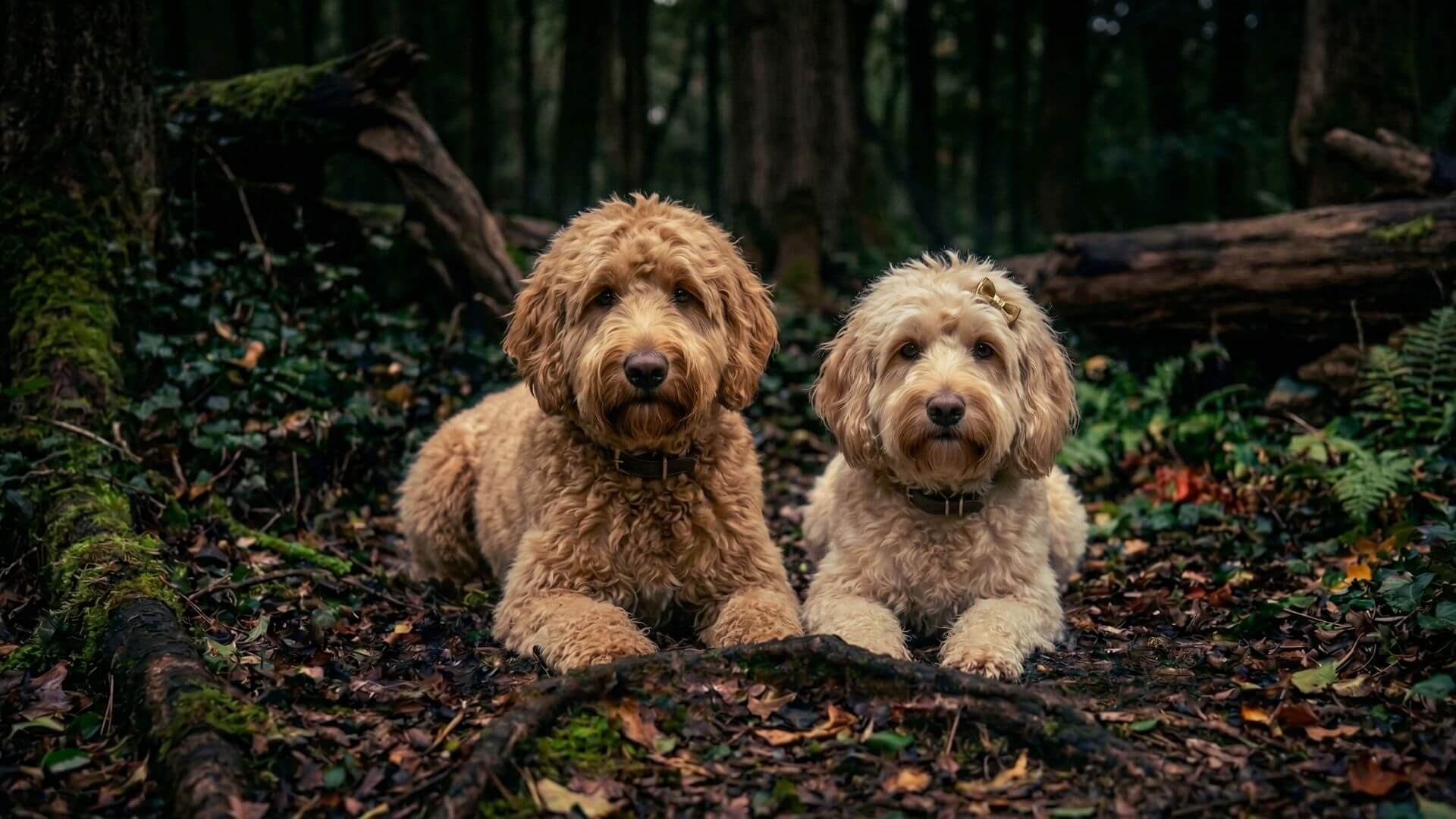
Goldendoodle Stud Dogs for Breeding
Browse verified Goldendoodle stud dogs with health testing from both parent breeds. Connect with responsible breeders matching F1, F1B, F2, F2B, and Multigen generations by region.
In This Guide
Featured Goldendoodle Studs
Health-tested and verified breeders ready to connect
Message stud owners directly. No middleman.
What Health Tests Should a Goldendoodle Stud Have?
A Goldendoodle is a designer cross between a Golden Retriever and a Poodle, so responsible breeding requires health testing from both parent breeds. The Golden Retriever Club of America (GRCA) and Poodle Club of America (PCA) have established testing protocols that apply to Goldendoodles.
Golden Retriever parent breeds should have OFA hip and elbow evaluations, annual ACVO eye exams, and DNA tests for EIC, prcd-PRA, and optionally NCL (Neuronal Ceroid Lipofuscinosis). Poodle parent breeds should have OFA hip and eye certifications, DNA tests for PRA, vWD (von Willebrand Disease), cardiac screening, and optionally neonatal encephalopathy testing.
Hip dysplasia affects both parent breeds. OFA ratings of Good or Excellent are required for breeding; Fair is acceptable but not ideal. Elbow evaluations follow the same standard: only Normal ratings pass. PennHIP is also accepted, with a distraction index below the breed median considered passing.
Eye exams must be performed by a veterinarian board-certified by the American College of Veterinary Ophthalmologists (ACVO) and registered with the OFA. These certifications expire after 12 months, so verify exam dates are current.
DNA testing prevents carrier-to-carrier pairings. EIC (Exercise-Induced Collapse) appears in Golden Retrievers; approximately 30 to 40% carry the DNM1 gene mutation. PRA (Progressive Retinal Atrophy) affects both breeds; prcd-PRA screening is critical. vWD (von Willebrand Disease) is common in Poodles; carriers produce affected puppies when bred together. NCL and cardiac issues may require additional screening depending on the stud’s pedigree.
All results should be registered with the OFA database and traceable to both parent breed lines. When reviewing stud profiles, ask for copies of health test results from both Golden Retriever and Poodle ancestry.
Learn more: Health Testing Before Breeding, Responsible Dog Breeding Guide
Health Tests from Both Parent Breeds
Responsible Goldendoodle breeding requires testing from Golden Retriever and Poodle standards
Golden Retriever Testing
Poodle Testing
How Much Does a Goldendoodle Stud Fee Cost?
Goldendoodle stud fees typically range from $800 to $3,500 or more, depending on generation, health testing, size variety, coat type, parent lineage, and breeding history.
Companion-quality studs with basic health testing from both parent breeds sit at $800 to $1,500. Studs with comprehensive testing (hips, elbows, eyes, EIC, PRA, vWD from both lineages) and proven breeding history command $1,500 to $2,500. Studs from champion Golden Retriever or Poodle lines with multiple generations of documented health clearances reach $2,500 to $3,500 or higher.
Generation affects pricing: F1 studs (first generation crosses, maximising hybrid vigour) often command premium fees. F1B studs (backcross, closer to pure Poodle or Golden Retriever) may vary depending on the direction of backcross. F2, F2B, and Multigen studs may cost less but offer more predictable coat and size outcomes.
Size variety also impacts fee. Standard Goldendoodles (50 to 90 lbs) are most common. Medium or Miniature varieties (25 to 50 lbs) appeal to different buyers and may have different pricing. Petite or Toy Goldendoodles (under 25 lbs) require smaller Poodle parents and are often priced higher relative to size.
Always ask what’s included in the fee: does it cover one or two breeding attempts, a live litter guarantee, or a return breeding if the litter is small?
Total breeding costs go beyond stud fees. Budget $100 to $200 for progesterone testing to time the breeding correctly, $200 to $500 for artificial insemination if using shipped semen, and $500 to $1,500 for whelping supplies and puppy care through 8 weeks.
Goldendoodles produce variable litter sizes depending on dam size and generation. Standard Goldendoodles typically deliver 6 to 10 puppies; smaller varieties produce 3 to 6. Natural breeding is common for similarly sized pairs, though AI may be necessary for size mismatches (standard male with miniature female). Cesarean sections are uncommon but possible depending on dam structure.
Get everything in writing. A stud contract should cover live litter guarantees, liability, health testing documentation, and what happens if the breeding doesn’t take.
Learn more: Stud Services for Dogs
Stud Fee Ranges
Typical pricing based on health testing, generation, and size
Total Breeding Budget
Stud fee to 8-week puppies
Ready to find the right stud? Browse Goldendoodle studs and connect with owners directly.
Browse Goldendoodle StudsGeneration Types: F1, F1B, F2, F2B, and Multigen
The most important consideration for Goldendoodles is generation, because it determines coat type, size predictability, and genetic composition. Unlike purebred dogs, each generation produces different outcomes.
F1 Goldendoodles are first-generation crosses: 50% Golden Retriever, 50% Poodle. F1 studs offer maximum hybrid vigour, reduced genetic health risks from having two different breed backgrounds, and unpredictable but often excellent temperament. Coat is typically wavy or curly, with moderate furnishings. Size varies but tends toward standard (50 to 90 lbs). F1 studs appeal to breeders seeking genetic diversity and puppies with strong health foundations.
F1B Goldendoodles are backcrosses: an F1 bred back to either a Golden Retriever or a Poodle, producing 75% of the backcross breed and 25% of the other. F1B to Poodle produces more predictable curly, low-shedding coats and smaller sizes. F1B to Golden Retriever produces wavier coats, larger size, and slightly more shedding. F1B studs appeal to breeders targeting specific coat or size outcomes.
F2 Goldendoodles are F1-to-F1 crosses: 50% Golden, 50% Poodle, but with unpredictable segregation at each gene locus. Coat varies widely: straight, wavy, or curly within the same litter. Size is less predictable than F1B. F2 studs are less common but attractive to breeders accepting diversity for the sake of genetic variety.
F2B Goldendoodles are F1 bred to F1B, producing 62.5% of one breed, 37.5% of the other. Coat and size predictability fall between F1B and F2. F2B studs appeal to breeders seeking a middle ground between consistency and diversity.
Multigen Goldendoodles are Goldendoodle-to-Goldendoodle crosses, with both parents being F1B or later generations. Coat is typically predictable curly, size is consistent, and the breed lines stabilise toward specific type. Many breeders prefer Multigen studs for stability and consistency, though some argue this reduces hybrid vigour compared to F1.
Goldendoodle Generations Explained
Each generation affects coat, size, and temperament predictability
Choosing which generation to pair with depends on your breeding goals. If you want maximum health heterozygosity and are comfortable with coat and size variation, pair with an F1 stud. If you’re targeting specific coat or size outcomes, pair with an F1B or F2B stud that complements your dam’s genetics. If you’re establishing a stable Multigen line, pair Multigen to Multigen.
Size Varieties: Standard, Medium, Mini, and Petite Goldendoodles
Goldendoodles come in multiple size varieties determined by which Poodle size is used in breeding: Standard Poodle (45+ lbs), Medium/Moyen Poodle (25 to 45 lbs), Miniature Poodle (10 to 15 lbs), or Toy Poodle (under 10 lbs).
Standard Goldendoodles are Golden Retriever crossed with Standard Poodle, producing dogs 50 to 90 lbs. These are the most common variety and appeal to buyers wanting a full-size companion. Standard studs are relatively abundant, and pricing is moderate compared to smaller varieties.
Medium or Miniature Goldendoodles are Golden Retriever crossed with Miniature Poodle, producing dogs 25 to 50 lbs. This size appeals to buyers with space constraints or preference for mid-size dogs. Medium studs command slightly higher fees due to smaller breeding population. Breeding Medium females to Standard males often requires artificial insemination to prevent injury.
Petite Goldendoodles are Golden Retriever crossed with Toy Poodle or small Miniature Poodle, producing dogs under 25 lbs. These appeal to apartment dwellers or buyers wanting lap dogs. Petite studs are less common and often carry premium pricing. Breeding always requires AI or careful supervision due to size disparity.
Toy Goldendoodles (under 10 lbs) are rare and typically result from F2 or Multigen breedings where both parents are small. Toy studs are very uncommon and may command the highest fees due to scarcity.
Goldendoodle Size Varieties
Parent breed combinations determine final size
Size variety affects stud selection significantly. A Standard dam paired with a Standard stud produces predictable Standard puppies. A Medium dam paired with a Standard stud requires AI and produces varied offspring (some Medium, some Standard). Ask stud owners about experience pairing with dams of different sizes, and discuss litter composition expectations.
Coat Type and Colour Genetics
Goldendoodle coat type is determined by the furnishings gene and coat texture genes inherited from parent breeds. Unlike purebred dogs with standardised coats, Goldendoodles have three main coat types, each with different grooming needs.
Curly-Coated Goldendoodles have tight, poodle-like curls, low shedding, and higher grooming demands. Curly coats result from curly coats in both parents or from inheriting the curly allele from one parent and the furnishings gene from both. Curly-coated studs appeal to buyers prioritising low shedding and hypoallergenic qualities.
Wavy-Coated Goldendoodles have a blend of straight and curly hair, creating a wavy texture. Wavy coats result from one parent contributing curly genetics and the other contributing straight genetics. Wavy-coated studs produce variable coats within litters, combining moderate shedding with easier grooming than curly coats.
Straight-Coated Goldendoodles have predominantly straight, shedding coats more like a Golden Retriever. Straight coats result from both parents contributing straight genetics. Straight-coated studs are less sought after but occur in F1 and F1B breedings, especially F1B to Golden Retriever backcrosses.
Furnishings (beard, moustache, eyebrows) are controlled by the furnishings (F) gene. Dogs with one or two F alleles (F/F or F/f) have furnishings; dogs with f/f have no furnishings (smooth face). Breeders often select studs with furnishings (F/F or F/f genotype) to ensure puppies have the characteristic Doodle appearance.
Colour Genetics in Goldendoodles follow Golden Retriever and Poodle colour patterns. Common colours include cream, apricot, red, chocolate, black, parti-colour (patches), phantom (tan points), and merle (mottled pattern). Goldendoodles do not have the full colour range of Labradors but can produce surprising outcomes depending on hidden recessive genes.
Cream and apricot are common, resulting from recessive e/e genotypes (similar to yellow Labs) combined with light coat genetics. Red Goldendoodles are apricots with deeper pigment. Chocolate Goldendoodles result from recessive b/b at the B locus (similar to chocolate Labs). Black Goldendoodles are dominant at the B and E loci.
Parti-colour Goldendoodles have patches or spots of different colours, often cream and black or apricot and black. Partis result from recessive alleles at the parti locus. Phantom Goldendoodles have a solid base colour with tan points (Golden Retriever or Poodle-style markings).
Merle Goldendoodles have a mottled pattern from the merle allele, inherited from Poodle ancestry. Merles are less common and sometimes controversial, as merle-to-merle pairings produce deaf or blind puppies. Ask stud owners about merle status and pedigree.
Learn more: DNA Testing Before Breeding, Genetics Guide, Stud Dog Directory
Coat Type Predictability
Determined by parental coat genetics and furnishings gene
Common Goldendoodle Colours
No breed standard colours (not AKC recognised)
How to Choose the Right Goldendoodle Stud
Start with health clearances from both parent breeds. Golden Retriever parent genetic line should have OFA hips rated Good or Excellent, elbows Normal, eye exam current, and EIC plus prcd-PRA DNA tests. Poodle parent genetic line should have OFA hips and eyes, prcd-PRA and vWD DNA tests. Verify results directly on the OFA database rather than relying on claims alone.
Next, verify generation. Determine whether you want maximum hybrid vigour (F1), specific coat and size outcomes (F1B, F2B), or established consistency (Multigen). Ask stud owner for documentation of both parents’ registration or genetic background to confirm generation designation.
Evaluate size variety compatibility. If your dam is Medium and you plan to breed to a Standard stud, confirm the stud owner has AI experience and understands the breeding logistics. Discuss expected litter composition, puppy sizing, and potential caesarean section scenarios.
Assess coat type genetics. If you’re breeding for curly, low-shedding puppies, pair with a curly-coated stud (ideally F/F furnishings). If you’re breeding wavy-coated pups with easier maintenance, pair with a wavy or curly stud carrying furnishings.
Check carrier status for recessive conditions. EIC, prcd-PRA, and vWD are avoidable through testing. Breeding two carriers produces affected puppies 25% of the time. Ask stud owner for full DNA results and carrier status for both parent breeds’ relevant tests.
Review pedigree and calculate coefficient of inbreeding (COI). Aim for COI below 6.25% to maintain genetic diversity. For designer crosses like Goldendoodles, ask for pedigree from both Golden Retriever and Poodle sides.
Look at breeding history. Has the stud produced healthy litters? Are previous dam owners willing to give references? A proven stud with documented offspring gives more confidence than an unproven dog.
If possible, meet the stud in person or request video showing his movement, temperament, structure, and coat type.
Use PairMyPet to browse stud profiles by breed and location, then message owners directly to discuss health clearances, pedigree, and breeding terms.
Stud Evaluation Checklist
Essential criteria when selecting a Goldendoodle stud
What to Look For (and What to Avoid)
Green Flags
- Shares full health test results from both parent breeds upfront
- Provides generation verification and pedigree documentation
- Offers stud contract with live litter guarantee
- Provides carrier status for EIC, PRA, vWD openly
- References from previous dam owners available
- Allows video calls or in-person visits
- Discusses AI requirements and experience
Red Flags
- Refuses to share health test results from both parent breeds
- Generation unclear or unverified
- No written stud contract
- Unmarked pricing (unusually cheap or vague)
- No carrier status information provided
- No references available
- Pressures quick decisions or non-refundable deposits
- Overpromises specific coat type or colour outcomes (cannot guarantee)
Know what to look for? Browse studs that meet your criteria on PairMyPet Stud Dogs.
Find Your Goldendoodle StudHow to Find a Goldendoodle Stud on PairMyPet
Finding a verified Goldendoodle stud takes four steps on PairMyPet. No cold-calling breeders, no scrolling Facebook groups for hours.
Create Your Dam’s Profile
Sign up and add your dam’s photo, breed, age, and a short description. This takes about 5 minutes. Your profile becomes searchable too, so stud owners can find you and reach out directly.
Browse by Breed
Browse stud profiles by breed and location. Review photos and descriptions to shortlist studs that match your breeding goals.
Compare Profiles
Compare stud profiles side by side. Look at photos, descriptions, and owner details before reaching out.
Contact & Discuss
Contact stud owners through PairMyPet’s messaging system. Ask about health clearances from both parent breeds, generation details, breeding terms, and stud contracts. Most owners respond within 24 hours.
Frequently Asked Questions
What health tests should a Goldendoodle stud have?
A Goldendoodle stud should have health testing from both parent breeds. From Golden Retriever heritage: OFA hip and elbow evaluations (Good or Excellent and Normal respectively), annual eye exam by ACVO ophthalmologist, and DNA tests for EIC and prcd-PRA. From Poodle heritage: OFA hips and eyes, plus DNA tests for prcd-PRA and vWD (von Willebrand Disease). Additional tests like NCL or cardiac screening may be recommended based on pedigree. Verify results on the OFA database.
What is the difference between F1, F1B, and F2 Goldendoodles?
F1 is 50% Golden Retriever, 50% Poodle, offering maximum hybrid vigour but unpredictable coat and size. F1B is backcrossed to either parent (75 and 25 percent split), producing more consistent coat and size but slightly reduced genetic diversity. F2 is F1-to-F1, producing high genetic diversity but even less predictability than F1. F1B to Poodle typically produces curly, low-shedding coats and smaller sizes. F1B to Golden Retriever produces wavy coats and larger sizes.
How much is a Goldendoodle stud fee?
Stud fees range from $800 to $3,500+ depending on health testing, generation, size variety, coat type, and breeding history. Companion-quality studs with basic health testing cost $800 to $1,500. Studs with comprehensive testing from both parent breeds and proven breeding history command $1,500 to $2,500. Premium studs from champion lines or rare size varieties reach $2,500 to $3,500 or higher. Size varieties (Standard, Medium, Mini, Petite) may affect pricing.
What is vWD in Goldendoodles?
von Willebrand Disease (vWD) is a bleeding disorder caused by a deficiency in von Willebrand factor, a blood clotting protein. Approximately 70% of Poodles carry the recessive mutation. Carriers show no symptoms, but when two carriers are bred together, 25% of puppies will be affected and may have severe bleeding issues. DNA testing identifies carriers. Breeding a carrier dam to a non-carrier stud prevents affected puppies.
Can Goldendoodles be bred naturally or do they need artificial insemination?
Goldendoodles of similar sizes can be bred naturally with supervision. Size mismatches (Standard male with Medium or Mini female) often require artificial insemination to prevent injury. Chilled semen can be shipped overnight and inseminated within 24 to 48 hours; frozen semen requires transcervical insemination with success rates of 80 to 87%. Discuss breeding method options with your veterinarian and stud owner based on the size compatibility of your dam and chosen stud.
How do I find a Goldendoodle stud near me?
Use PairMyPet to browse Goldendoodle studs by breed and location. Review profiles, then message stud owners directly to ask about health clearances and breeding terms. Include your dam’s generation and size in your initial message.
What is the coefficient of inbreeding (COI) and why does it matter?
The coefficient of inbreeding is a percentage representing the probability that alleles inherited by a puppy are identical copies of the same ancestral allele. High COI increases the risk of inheriting recessive genetic diseases. Aim for COI below 6.25% to maintain genetic diversity. For Goldendoodles, ask stud owners for pedigrees spanning at least five generations from both Golden Retriever and Poodle sides if available.
What should a Goldendoodle stud contract include?
A stud contract should cover the stud fee amount, number of breeding attempts included, live litter guarantee terms, return breeding policy if the litter is small, health testing documentation from both parent breeds, carrier status for EIC, PRA, and vWD, liability for veterinary complications, and breeding method expectations (natural vs. AI). If AI is planned, confirm who covers the AI cost. Get everything in writing before the first breeding attempt.
Find Your Perfect Goldendoodle Stud
Finding the right stud takes research, but it sets up your litter for health, temperament, and longevity. Use PairMyPet to connect with verified breeders who’ve invested in comprehensive health testing from both parent breeds, thoughtful generation planning, and responsible breeding practices.
Get Started