
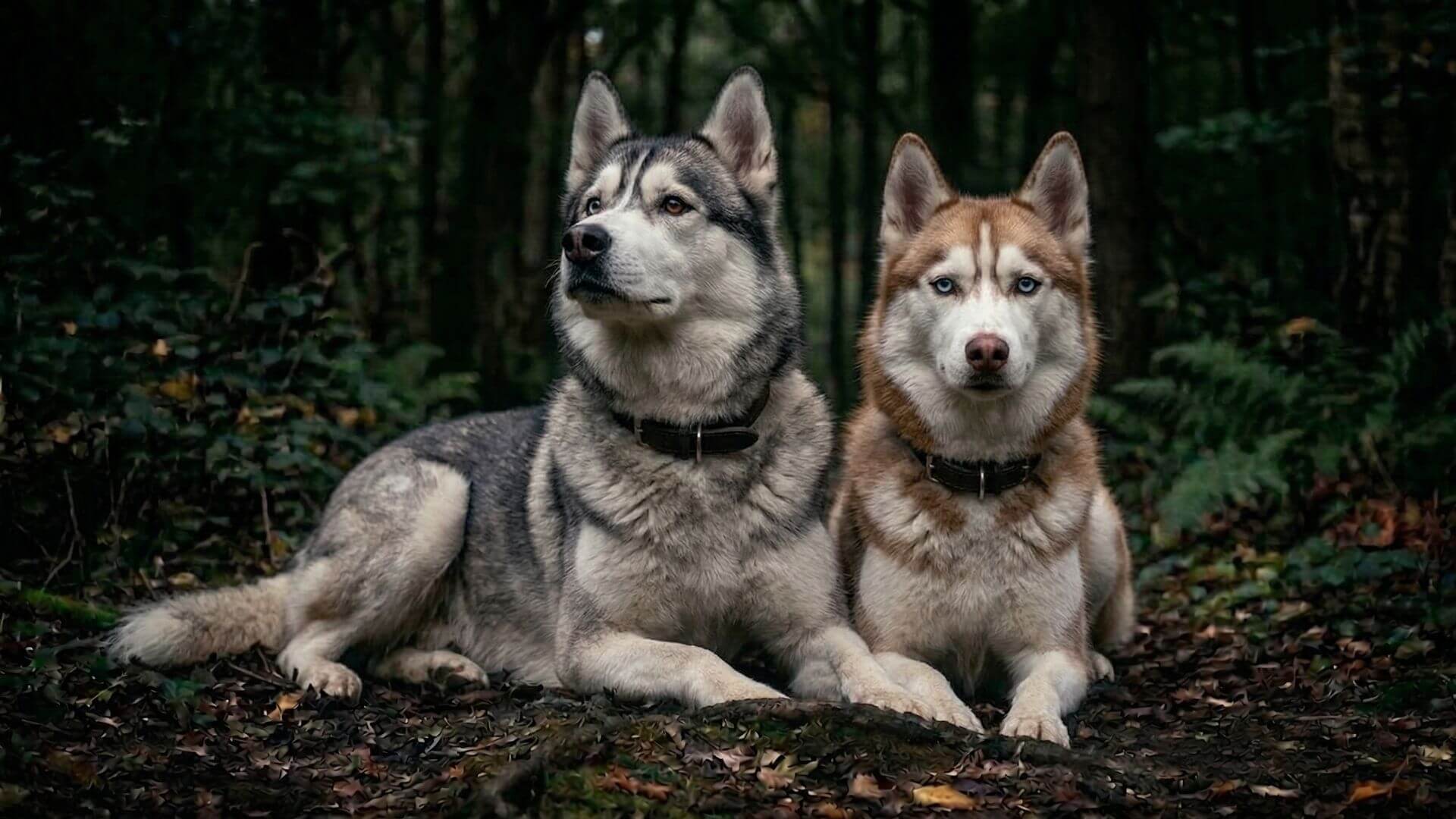
Siberian Husky Stud Dogs for Breeding
Browse verified Siberian Husky stud dogs with OFA hip evaluations, ophthalmologist eye certifications, and genetic screening. Connect with responsible breeders near you.
In This Guide
Featured Siberian Husky Studs
Health-tested and verified breeders ready to connect
Message stud owners directly. No middleman.
What Health Tests Should a Siberian Husky Stud Have?
A Siberian Husky stud should have OFA hip evaluation, eye certification from a board-certified veterinary ophthalmologist, and genetic testing for hereditary cataracts per the Siberian Husky Club of America and CHIC program guidelines.
Hip dysplasia screening is essential because although Siberian Huskies have a lower overall rate of hip dysplasia compared to larger breeds, affected dogs still exist in the population. OFA ratings of Good or Excellent are appropriate for breeding. Fair is borderline and should be evaluated carefully with a reproductive veterinarian before breeding. PennHIP is also accepted, with a distraction index below the breed median.
Eye exams are critical and must be performed by a veterinarian board-certified by the American College of Veterinary Ophthalmologists (ACVO). Siberian Huskies are prone to juvenile cataracts (typically appearing before age 3) and corneal dystrophy. Eye certifications expire after 12 months, so verify the exam date is current. Results must be registered with the OFA for verification.
Genetic screening focuses on hereditary conditions specific to the breed. Juvenile cataracts can be inherited, so ask for genetic testing results that identify carrier status. Corneal dystrophy is another concern; while many cases are not hereditary, screening helps identify affected individuals. Progressive retinal atrophy (PRA) has been reported in Huskies, though it is relatively uncommon. Zinc deficiency (zinc-responsive dermatosis) can affect breeding stock, and supplementation protocols should be discussed with the stud owner if relevant.
All results should be registered with the OFA database and verified through the CHIC program. A CHIC number confirms that all required tests have been completed, though it does not guarantee the results. When reviewing stud profiles, ask for copies of all test results and CHIC documentation.
Learn more: Health Testing Before Breeding
CHIC Health Tests for Siberian Huskies
Essential evaluations for responsible Husky breeding
How Much Does a Siberian Husky Stud Fee Cost?
Siberian Husky stud fees typically range from $400 to $2,500 or more, depending on OFA scores, pedigree quality, competitive titles, and breeding history.
Companion-quality studs with basic health clearances sit at $400 to $1,000. Studs with full OFA hip clearance, current eye certification, and documented breeding history command $1,000 to $1,500. Working line studs with sled racing titles, show-quality studs with conformation titles (CH), or studs with multiple generations of health clearances reach $1,500 to $2,500.
Always ask what’s included in the fee: does it cover one or two breeding attempts, a live litter guarantee, or a return breeding if the litter is small?
Total breeding costs go beyond stud fees. Budget $100 to $200 for progesterone testing to time the breeding correctly, $200 to $500 for artificial insemination if using shipped semen, and $300 to $1,200 for whelping supplies and puppy care through 8 weeks.
Siberian Huskies typically deliver naturally but are seasonal breeders. Most females cycle once per year, usually in winter months. This seasonality affects breeding timing and availability of studs. Litters are moderate in size (4 to 8 puppies on average), making whelping and puppy care less intensive than large-breed litters.
Cesarean sections are uncommon in the breed, which keeps surgical costs off the budget. However, prepare for potential dietary, supplement, and veterinary monitoring costs during the nursing period.
Get everything in writing. A stud contract should cover live litter guarantees, liability, health testing proof, return breeding policy if the dam fails to conceive, and timing considerations for seasonal breeding.
Learn more: Stud Services for Dogs
Stud Fee Ranges
Typical pricing based on pedigree and certifications
Total Breeding Budget
Stud fee to 8-week puppies
Ready to find the right stud? Browse Siberian Husky studs and connect with owners directly.
Browse Siberian Husky StudsDo Siberian Huskies Need Artificial Insemination?
No, Siberian Huskies are structurally built for natural breeding and most pairings happen without AI. Their athletic frame and strong breeding drive make natural mating the standard approach.
AI becomes relevant in specific situations. First, when the dam and stud are in different regions and the stud owner ships chilled or frozen semen. Second, when a reproductive veterinarian recommends it due to timing challenges related to seasonal cycling or the dam’s previous breeding difficulty.
Siberian Huskies are seasonal breeders, typically cycling once per year in winter. This narrow breeding window means timing is critical. Progesterone testing helps pinpoint ovulation accurately. Chilled semen ships overnight and is inseminated within 24 to 48 hours, with conception rates of 70 to 80% when properly timed. Frozen semen requires transcervical insemination (TCI) or surgical implantation, with success rates of 80 to 87% when timing is managed with progesterone testing.
For local pairings, natural breeding with veterinary supervision is the simplest path. For long-distance pairings, AI opens up access to studs from different regions or working lines that you couldn’t reach otherwise.
Discuss breeding method options with both the stud owner and your reproductive vet before committing. Understanding the dam’s cycle and the stud’s breeding history is essential for planning.
Learn more: Breeding Guide
Working vs Show Lines: Which Stud Is Right for You?
Siberian Huskies have diverged into two distinct types based on breeding purpose. Both are the same breed per the AKC breed standard, but they differ in structure, drive, and temperament.
Show (Conformation) Huskies are bred for the conformation ring and companionship. They have balanced, proportional builds emphasizing structural beauty. Temperament is stable and handler-oriented, though the breed’s natural prey drive and pack mentality remain intact. They excel in conformation competition and make steady family companions. Energy levels are high; approximately 1 to 1.5 hours of daily activity is typical, though some individuals need more.
Working (Sled Racing) Huskies are bred for speed, endurance, and sled racing performance. They have leaner builds with long, powerful strides optimized for pulling. Their drive is extremely high, and they are intensely focused on running. Working Huskies are competitive in sprint racing, distance racing, and skijoring. They require 2+ hours of vigorous daily exercise or have an outlet for their prey drive. These dogs are not ideal for most household situations without serious commitment.
Working vs Show Siberian Huskies
Working (Sled Racing)
- Leaner, longer-legged build optimized for speed
- Intense prey drive and pack mentality
- Bred for sprint and distance racing
- Extremely high energy, constant motion drive
- 2+ hours vigorous daily exercise required
- Not suitable for typical family homes
Show (Conformation)
- Balanced, proportional structure per AKC standard
- Stable temperament, handler-oriented
- Bred for conformation ring excellence
- High energy but more manageable than working
- 1–1.5+ hours daily activity sufficient
- Better suited to family companions with active owners
Your breeding goals determine which type to choose. If your dam is a show dog and your buyers want conformation prospects or family companions, pair with a show stud who complements her structure and temperament. If your dam is working-bred and your buyers seek racing partners or working dogs, match with a working stud carrying sled racing pedigree.
Some breeders intentionally cross the types to balance the high drive of working lines with the structural soundness and moderate temperament of show lines. This is a more advanced pairing decision that requires understanding what each type contributes to puppies.
Eye Colour and Coat Genetics: Understanding Husky Diversity
Siberian Huskies are famous for their striking eye colours and patterns. Unlike many breeds where eye colour variations signal problems, Huskies celebrate diversity. The breed standard recognises blue, brown, bi-eyed (one blue and one brown), and parti-eyed (partially blue and partially brown) patterns. All are equally desirable and have no health implications.
Blue eyes are caused by low melanin levels in the iris. Brown eyes result from higher melanin. Bi-eyed Huskies have heterochromia (two different eye colours), which is completely normal in this breed and highly prized. Parti-eyed Huskies have sections of blue and brown within each eye. None of these patterns indicate disease or carrier status for hereditary eye conditions; they are simply colour variations.
Coat colour and patterns are equally diverse. The breed standard recognises black and white, grey and white, red and white, agouti, sable, and all-white. Piebald patterns (irregular white patches) are common. Some Huskies have facial markings that resemble wolves, while others have symmetrical facial patterns. All coat colours and patterns are equally valid per the AKC breed standard.
Coat genetics in Huskies are complex but important to understand. The E locus (Extension) controls whether pigment is deposited. Agouti patterning comes from the A locus (Agouti). The S locus (Spotting) controls white markings and can produce piebald patterns. Sable colour is a modifier that dilutes base colour in specific patterns.
All eye colours and coat patterns are valid for breeding. There are no genetic tests that restrict pairing based on eye colour or coat colour diversity. Breeders can confidently pair blue-eyed Huskies together, or match blue-eyed with brown-eyed Huskies, and both pairings are equally sound.
Learn more: DNA Testing Before Breeding, Stud Dog Directory
Siberian Husky Eye Colours and Patterns
All AKC recognised — no health implications
Parti-eyed and Mixed Patterns
- Parti-eyed: Sections of blue and brown within same eye, creates striking appearance
- All patterns are AKC standard and have no health implications
- Eye colour does NOT indicate carrier status for hereditary eye diseases
Coat Colours and Markings (AKC Standard)
- Black/White, Grey/White, Red/White: standard colour combinations
- Agouti, Sable: banded and tipped coat patterns
- All-White: rare but recognised, blue eyes common with white coat
- Piebald: irregular white patches, natural to breed
- Facial Markings: range from symmetrical “spectacles” to asymmetrical wolf-like patterns
How to Choose the Right Siberian Husky Stud
Start with health clearances. OFA hips rated Good or Excellent, eye exam current (within 12 months) by ACVO-certified ophthalmologist, and genetic testing completed for hereditary cataracts and corneal dystrophy. Verify results directly on the OFA database rather than relying on claims alone.
Assess breeding purpose alignment. Show-quality Huskies should have balanced conformation and handler-oriented temperament. Working-bred Huskies should have documented racing pedigree and proven athletic bloodlines. Understand the difference and choose a stud that matches your dam’s purpose and your buyers’ expectations.
Evaluate temperament beyond the ring or racing arena. Siberian Huskies should be friendly, confident, and pack-oriented without excessive aggression or fear. Assess prey drive, pack mentality, and trainability. Wolves and wolf-dogs are not allowed in many jurisdictions; ensure your stud has a well-documented pedigree of purebred Huskies only.
Review the stud’s pedigree and calculate the coefficient of inbreeding (COI). Aim for COI below 6% to maintain genetic diversity. Ask the stud owner for a five-generation pedigree.
Look at breeding history. Has the stud produced healthy litters? Are previous dam owners willing to give references? A proven stud with documented offspring gives you more confidence than an unproven dog.
If possible, meet the stud in person or request video showing his movement, temperament, and structure. Pay special attention to his recall, response to other dogs, and energy level in a home environment.
Use PairMyPet to browse stud profiles by breed and location, then message owners directly to discuss health clearances, pedigree, and breeding terms.
Understanding Recessive Inheritance in Huskies
How hereditary conditions are passed
Stud Evaluation Checklist
Essential criteria when selecting a Siberian Husky stud
What to Look For (and What to Avoid)
Green Flags
- Shares full OFA/CHIC results upfront
- Offers stud contract with live litter guarantee
- Documents genetic testing results openly
- References from previous dam owners available
- Allows video calls or in-person visits
- Transparent about seasonal breeding timing
Red Flags
- Refuses to share health test results
- No written stud contract
- Vague about genetic carrier status
- No genetic testing despite breeding Huskies
- Claims wolf or part-wolf content
- Pressures quick decisions or non-refundable deposits
Know what to look for? Browse studs that meet your criteria.
Find Your Siberian Husky StudHow to Find a Siberian Husky Stud on PairMyPet
Finding a verified Siberian Husky stud takes four steps on PairMyPet. No cold-calling breeders, no scrolling breed clubs for hours.
Create Your Dam’s Profile
Sign up and add your dam’s photo, breed, age, and a short description. This takes about 5 minutes. Your profile becomes searchable too, so stud owners can find you and reach out directly.
Browse by Breed
Browse stud profiles by breed and location. Review photos and descriptions to shortlist studs that match your breeding goals.
Compare Profiles
Compare stud profiles side by side. Look at photos, descriptions, and owner details before reaching out.
Contact & Discuss
Contact stud owners through PairMyPet’s messaging system. Ask about health clearances, OFA scores, breeding terms, and stud contracts. Most owners respond within 24 hours.
Frequently Asked Questions
What health tests should a Siberian Husky stud have?
A Siberian Husky stud should have OFA hip evaluation rated Good or Excellent, an annual eye exam by an ACVO-certified ophthalmologist, and genetic testing for hereditary cataracts and corneal dystrophy. The Siberian Husky Club of America and CHIC program define these as the breed standard for responsible breeding. Verify results directly on the OFA database.
How much is a Siberian Husky stud fee?
Stud fees range from $400 to $2,500+ depending on pedigree, OFA scores, titles, and breeding history. Companion-quality studs cost $400 to $1,000. Show or working-bred studs with full health clearances and proven bloodlines reach $1,500 to $2,500. Always ask what’s included (breeding attempts, live litter guarantee, return breeding). Some stud owners offer pick-of-litter agreements as an alternative.
Are blue eyes in Siberian Huskies a sign of genetic problems?
No, blue eyes in Siberian Huskies are completely normal, healthy, and highly valued. Heterochromia (bi-eyed, with one blue and one brown eye) is also perfectly healthy and desirable. Eye colour has no link to hereditary eye diseases like juvenile cataracts or corneal dystrophy. These conditions are screened through veterinary eye exams, not eye colour.
What is juvenile cataracts in Siberian Huskies?
Juvenile cataracts are clouding of the lens that appear early in life, typically before age 3. The condition can be hereditary. Affected dogs may experience reduced vision or blindness if both eyes are affected. Eye exams by an ACVO ophthalmologist, registered with OFA, identify both affected and carrier Huskies. Genetic testing can sometimes identify carrier status.
How do I find a Siberian Husky stud near me?
Use PairMyPet to browse Siberian Husky studs by breed and location. Review profiles, then message stud owners directly to ask about health clearances and breeding terms.
What is the difference between working and show Siberian Huskies?
Working (sled racing) Huskies are bred for speed, endurance, and pulling power. They have leaner builds and extremely high drive. Show (conformation) Huskies are bred for balanced structure and conformation ring excellence. They have more moderate temperaments. Both are the same breed per the AKC standard. Your breeding goals and puppy buyer market determine which type to pair with.
Why is seasonal breeding important for Siberian Huskies?
Siberian Huskies are seasonal breeders, typically cycling once per year during winter months. This narrow breeding window means timing is critical and affects availability of both dams and studs. Plan breeding well in advance and use progesterone testing to pinpoint ovulation accurately during the dam’s heat cycle.
What should a stud contract include?
A stud contract should cover the stud fee amount, number of breeding attempts included, live litter guarantee terms, return breeding policy if the dam fails to conceive, health testing documentation, genetic carrier status, and timing considerations for seasonal breeding. Get everything in writing before the first breeding attempt.
Find Your Perfect Siberian Husky Stud
Finding the right stud takes research, but it sets up your litter for health, temperament, and longevity. Use PairMyPet to connect with verified breeders who’ve already invested in OFA certifications, eye health screening, and thoughtful genetic planning.
Get Started